Opening The Rift
therift
© 2026 The Rift. All Rights Reserved.
Passive Euthanasia Law India: Supreme Court Ruling Exposes a Legislative Void
A landmark decision allowing the withdrawal of life support for a man in a 13-year vegetative state is a triumph of compassion—but it exposes the paralyzing absence of federal action.

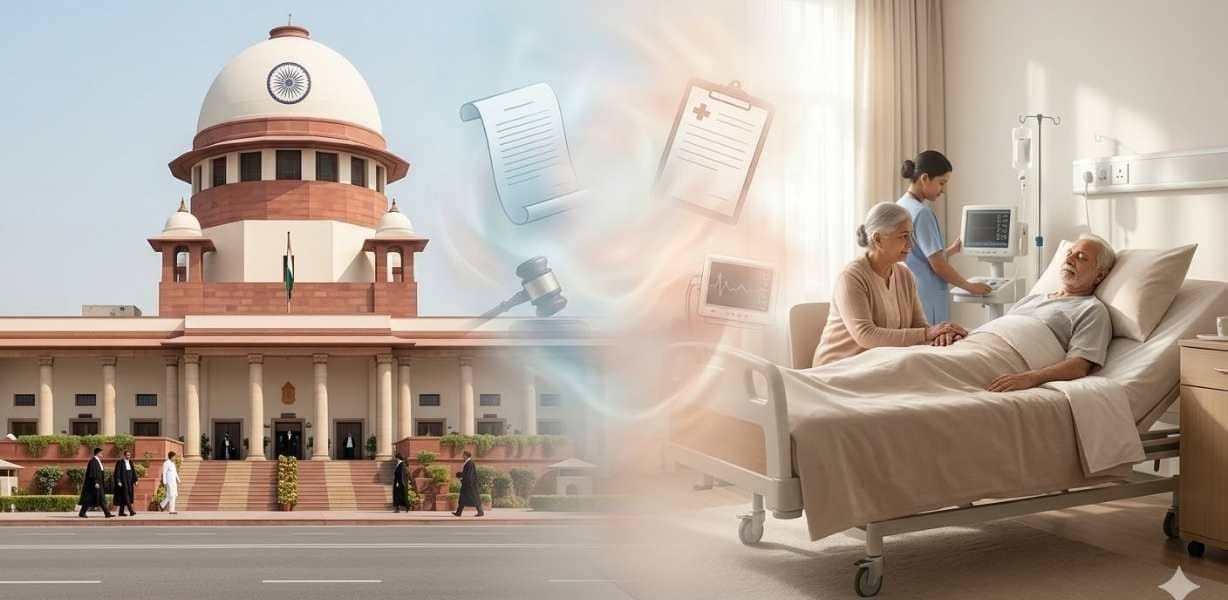
Illustrative Image
Key Takeaways
1 of 3
Automatically generated. Read full article for complete context.
For over a decade, Harish Rana’s family has been trapped in a medical and legal purgatory. After a severe accident in 2013 left the 32-year-old in a persistent vegetative state, his existence became inextricably bound to Clinically Administered Nutrition and Hydration (CANH). In March 2026, the Supreme Court of India officially permitted his family to withdraw his life-sustaining treatment, allowing him the constitutional right to die with dignity. The ruling is a watershed moment for medical ethics in India, representing the first practical application of the nation’s passive euthanasia India law framework.
Yet, beyond the immediate relief for Rana’s family, the judgment handed down by Justices J.B. Pardiwala and K.V. Viswanathan serves as a sharp indictment of legislative paralysis. Why should a family’s agonizing decision to let a loved one depart peacefully require the final stamp of the nation’s highest constitutional court?
The Judicial Weight of “Best Interests”
The Court emphasized that withdrawing treatment in cases of irreversible vegetative states is not an act of abandonment, but a recognition that prolonging biological life is no longer in the patient’s best interest. Acting on the unanimous consensus of medical boards, the Court directed that Rana be admitted to the palliative care department at AIIMS, New Delhi, to ensure his passing is conducted humanely.
However, placing this burden entirely on judicial mechanisms is fundamentally flawed. In the Common Cause v. Union of India judgment of 2018 (modified in 2023), the Court laid out complex guidelines to validate living wills and passive euthanasia. But guidelines are not laws. The current process remains a bureaucratic maze of medical boards, deeply traumatizing for families already grappling with profound grief. Navigating this labyrinth to secure what the Supreme Court recognizes as fundamental to Article 21 of the Constitution—the right to live and die with dignity—remains a privilege only accessible to those with the means to endure prolonged litigation.
The Legislative Void
The Supreme Court has now explicitly urged the Central government to enact a comprehensive federal law governing passive euthanasia and end-of-life care. While courts can interpret constitutional rights on a case-by-case basis, only Parliament can build the robust, accessible, and standardized palliative framework required for a nation of 1.4 billion people.
A statutory law would democratize dignity. It would standardize the thresholds for medical consensus, decentralize decision-making away from courtrooms to specialized ethics committees, and protect doctors from legal ambiguity. By refusing to legislate, Parliament is essentially forcing citizens to trade their dignity for courtroom theater. The Harish Rana case proves that the medical ethics of passive euthanasia are settled; it is time for the law to catch up.