Opening The Rift
therift
© 2026 The Rift. All Rights Reserved.
The hope for masculinity: Karthik Subbaraj’s call to men in Dorothy
Ashley Tellis argues that Karthik Subbaraj’s Dorothy carries the most incendiary critique of masculinity but also hope for it

Key Takeaways
1 of 3
Automatically generated. Read full article for complete context.
In 1928, Tamil social reformer and anti-caste activist E. V. R. Periyar wrote an article ‘‘Masculinity’ Must be Destroyed for Women’s Liberation’ in his book Why Were Women Enslaved? In it, he argued that the word masculinity itself was an affront to women, built as it is on misogyny. In a recent collection of his speeches at various caste associations, Periyar offers a stinging critique of men and masculinity across castes. The male, activist, OBC Periyarites (Periyar was OBC) ignore that critique and when the brilliant feminist historian S. Anandhi highlighted the critique of masculinity across castes in those speeches in a recent public talk around the book (https://www.youtube.com/watch?v=M_l5CNoNRQQ&t=49s) , it did not go down well with them.
Karthik Subbaraj offers a similar, Periyarist critique of Dalit and OBC and upper caste, in effect, of all men in Dorothy. The immense homophobia that the film has been receiving with death threats to the heroes and people who are liking it online actually masks the raw nerve that has been hit – their anger is really with the critique of masculinity in the film. This is not a new critique for Subbaraj. It is present in many of his earlier films, particularly Iraivi. Iraivi fared terribly at the box office and with so-called film critics. Tamil men, across castes, do not want to hear any critique of their great selves.
But a close attention to the text of Dorothy and its mediations of masculinity is deeply rewarding. As one soaks in the sheer sensorium of the filmic text – the extraordinary editing, the stunning cinematography, the orchestral, shattering euphony (truly an experience of the sublime) of Ilayaraja’s musical score, the sheer beauty of its male protagonists, the floating dead bodies of women, the crying of the women still alive, the scintillating script, at once poetic, subtle, deeply humane and scissors-sharp – one realises that men are being slapped. Really hard. And it is a slap worth spending some time over, as opposed to the shallow slap in the hideous anti-feminist posing-as-feminist Hindi film, Anubhav Sinha’s Thappad. Luckily for us, Subbaraj is no Sinha.
Before we analyse that slap, we need to get the question of violence out of the way. Carpin critics always complain about the violence in Subbaraj’s films. Apart from the fact that this is 80s Madurai, violence is never gratuitous in Subbaraj’s films. It is always transitive, like melodrama historically, moving to mark a transition. The men can barely see who they murder, they recoil from it even as they perform it. It is the only language given to them by patriarchy and they are impelled by it like the brothers in Gabriel García Márquez’s Chronicle of A Death Foretold. They do not want to murder their sister’s lover but as men they are expected to. They have to. It is almost a rite de passage.
The crux of Subbaraj’s vision is that it is not a compulsory rite de passage; it can be broken with. In Subbaraj, there are two kinds of men: hegemonic men, wounded by, and wounding, others through their violent masculinity, with its repressions and excisions, on the one hand. And men who freely partake of the feminine, on the other. This is not a binary in Subbaraj as he is not a binary thinker, cinematically or otherwise. His hegemonic men can and do cry (even the most repulsive of them has a tear trickling down his face in one scene, as he plots to kill his own son) and his womanly men can get violent and kick rapist North Indian nutbars really hard in the nuts.
Indeed, crying is central to the film. If you are a man who can cry, Subbaraj seems to suggest, you can change the world. The two central protagonists have very different relationships to crying. One cries easily, and all the time. The other only repeats the cultural injunction: Boys/Men don’t cry. At a very interesting moment, a woman in the film, tells another kind of woman not to cry. ‘Women don’t cry,’ she says. But, as they hug, we see a tear trickling out of her eye. Tears have histories in Dorothy and we have to value them in women and, and perhaps especially, in men.
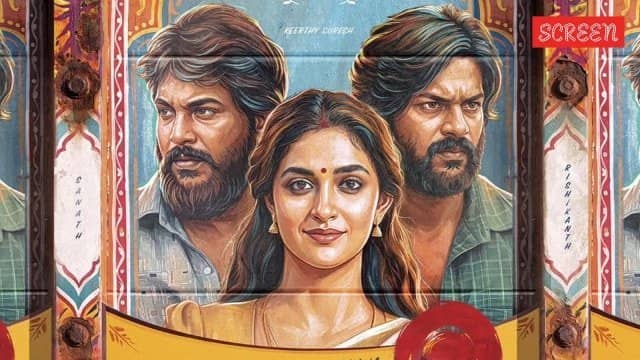
At the heart of the film is the relationship between two men who start out as boys, in an inverted pattern from what they embody as adults. The one who comes from a family full of abusive violent OBC men is the equally violent, macho (Bruce Lee is his inspiration) protector at school and elsewhere, telling his friend not to cry, as men don’t cry, telling the friend while watching a film that they have to learn how to kiss girls, telling the friend to ‘be a man’; the sensitive Dalit boy is the protected one, cries easily and is horrified by violence.
By the time they grow up, the Dalit boy has become the macho man who kills people without blinking and the OBC boy has become the sensitive one, crying easily, has a mincing walk and has to hide his ‘real self’/’true nature’ as an aravani. The Dalit boy has no father and is supported by his paniyaram-selling, independent, working mother; the OBC boy has no mother, no female person in the house and is brutalised by men.
The frame is set for a clash of two world views but also, inevitably of deep desire between the two. Both boys/men are surrounded, almost foetally, by a watery, uterine body of women, some dead, some alive: the Dalit boy’s mother, the murdered mother and sister of the OBC boy (the sister killed because she transgressed caste and fell in love with a boy of another caste), a girlfriend (of the Dalit boy whom he is severed from because of his caste), a female friend and confidant of the OBC boy) and then, the eponymous, mysterious, and magical Dorothy, who becomes the alter ego of the OBC boy, who finally, in a radiant transformation, becomes her.
But the two men also have a deep love for each other; the OBC boy is clearly in love with the Dalit boy. As the OBC boy becomes more and more reconciled to the feminine in him, despite his fear that if he reveals it, he will lose his best friend and his only love, he is more inclined to tell his Dalit best friend of his love. By the time, he becomes an aravani, though, all hell has broken loose.
Yet it leads him directly back into the arms of the Dalit boy, who, he now learns, is a raging homophobe, who spits at him, abuses him, rejects him. But whom/what is the Dalit boy really rejecting? Is he really only rejecting the female inside himself, accepting which will make him realise that his best friend is also his real true love? That a French kiss might also be had with that friend? The nervy brilliance of Rishikant’s performance means that these contrary pulls flutter across his face, torment him and torment us.
It may be argued that the film only accepts gay love between two men only when one of them literally and metaphorically embodies the feminine. But that is not really Subbaraj’s point. His point is that if only men realised that they are also women and women realised that they were also men and that both realised the fluid and shaky (even as it appears unshakeable and unbreakable) psychic reality of what Freud called the principle of sexual difference and, as a result, all identity formation, we would begin to be free of a world full of caste violence and sexual violence and not feel the desire for denial, erasure and murder of any kind.
It is a utopian vision, no doubt, but one worth dreaming of. As feminist Jacqueline Rose put it, suffering, beyond the limits of endurance, only increases the enchantment of the world. Or words to that effect. Subbaraj’s film is enchanting; it is a gauntlet thrown down to Tamil, and all, men. It is up to them to pick it up. That’s the real fight for men. The fight to become fully human.
Disclaimer:The views and opinions expressed in this article are those of the author(s) and do not necessarily reflect the official policy or position of The Rift.
*DorothyAshley TellisCaste and GenderFilmFilm CriticismIlayarajaKarthik SubbarajMasculinityMoviePeriyarQueer CinemaRishikantTamil Cinema