Opening The Rift
therift
© 2026 The Rift. All Rights Reserved.
How Dare You Ask a Question? We Invented Zero
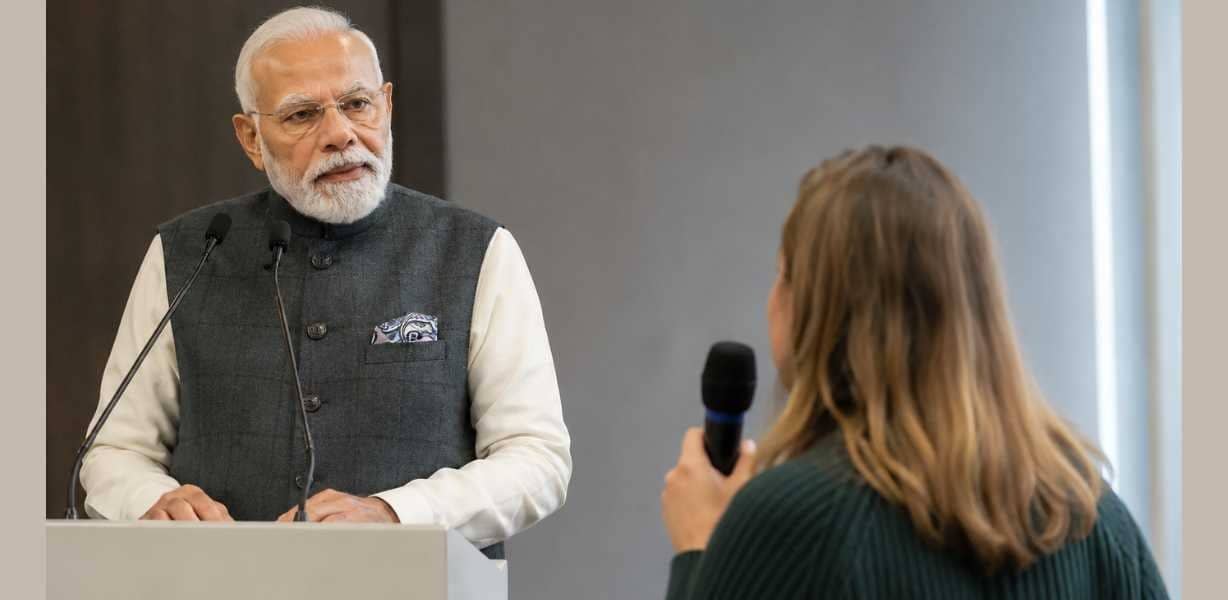
The question was about press freedom and government credibility, The Sibi George told her that chess originated in India, that zero originated in India, that yoga originated in India, and that India had epics and books.

Representative Image
Key Takeaways
1 of 3
Automatically generated. Read full article for complete context.
A Norwegian journalist asked the Indian foreign ministry why anyone should trust India. The ministry responded by informing her that India invented zero.
Sibi George, MEA Secretary (West)MEA Secretary (West)A senior Indian Foreign Service officer heading the Ministry of External Affairs which covers Europe, the Americas, and international organisations. Essentially the diplomat dispatched to handle the West., was fielding questions in Oslo during Prime Minister Modi’s Norway visit when a reporter from DagsavisenDagsavisenA Norwegian daily newspaper based in Oslo, founded in 1884. Historically linked to the Labour Party, now editorially independent. One of Norway’s oldest and most widely read broadsheets. asked a question so offensive, so drenched in colonial entitlement, that it required the full weight of five thousand years of civilisational history to answer. She asked: “Why should we trust you?” And George, the professional that he is, did not blink. He told her India has a constitution. He told her India gave women the right to vote in 1947. He told her about 200 TV channels in Delhi alone. And then, because the question was about press freedom and government credibility, he told her that chess originated in India, that zero originated in India, that yoga originated in India, and that India had epics and books.
The journalist, presumably, did not ask a follow-up about whether shoonyaShoonya (शून्य)The Sanskrit-origin word for zero. The concept of zero as a number not just a placeholder was formalised in India by mathematician Brahmagupta in 628 CE. Now apparently also a diplomatic talking point. had a comment on the PM skipping the Q&A.
This Is My Press Conference, Says the Man Defending Why There Isn’t One
The best part and there are several best parts, all competing, was when the Norwegian journalist interrupted George mid-answer. He stopped her. “Let me answer the question,” he said. “This is my press conference.”
Let’s sit with that for a second. The MEA official defending the Prime Minister’s right to not hold a press conference asserted ownership over his own press conference. The irony didn’t need writing. It arrived fully formed, in English, on camera, in Oslo, and walked itself into every headline. This is the kind of moment that makes satirists redundant.
George then explained India’s media ecosystem. “You know how many stories are up here,” he said. “At least 200 TV channels in Delhi alone, in English language, in Hindi language and multiple languages. People have no understanding of the scale of India.”
Two hundred channels. This is true. What George did not mention and what the Norwegian journalist was too polite to Google on the spot is what those 200 channels are actually doing at 9 PM on any given weekday. The answer, for anyone who has access to a remote control and a functional stomach, is roughly: four of them are running the same government press release as BREAKING, six are screaming at a Muslim and Opposition panelists, and the remaining 190 are showing the same cricket highlights. This is press freedom, measured in volume. India has a lot of it. It’s just not pointed at the government.
We Gave Women the Vote in 1947, Please Stop Asking About 2026
George’s most creative move was the pivot to women’s suffrage. “In 1947, we gave the freedom to vote for our women,” he said. “Many countries I know, the voting right for women came several decades after India gave that freedom.”
This is aimed at Europe. Specifically, it’s aimed at Switzerland, which gave women the right to vote in 1971. And it lands. India did give women the vote from day one. This is a genuine, documented, constitutional achievement that deserves credit. It also has absolutely nothing to do with the question that was asked, which was about the current Prime Minister’s refusal to take questions from the press, which is a thing that is happening right now, in 2026, not in 1947.
But the 1947 flex works beautifully as a rhetorical device, because it reframes the conversation from present accountability to historical achievement. You can’t criticise us for what we’re doing today, because look at what we did 79 years ago.
It is the same Desi version of “Hamare Jawan Border Pe Ladh Rahe Hain” — which, translated for the benefit of the West, means “Please stop asking about the poor sanitation in our cities because our soldiers are fighting on the border.”
The Prime Minister of India has not held a solo, open, unscripted press conference since he took office in 2014. His predecessor, Manmohan SinghManmohan SinghIndia’s 13th Prime Minister (2004–2014), Congress-led UPA. An economist credited with India’s 1991 liberalisation. Often mocked by opponents for being ‘silent,’ he held 117 press conferences in 10 years — a detail that ages differently with each passing year of his successor’s tenure., held 117 in ten years. Rajiv Gandhi held over 60, including the first nationally televised live presser in 1985. The current PM did hold one, in May 2019. He sat next to Amit Shah. Shah answered the questions. The PM sat. It was a press conference the way a forwarded email is a reply.
India is ranked 157th out of 180 countries on the 2026 World Press Freedom IndexWorld Press Freedom IndexAn annual ranking of 180 countries by Reporters Without Borders (RSF), measuring press freedom based on five indicators: political context, legal framework, economic context, sociocultural context, and safety of journalists. India dropped from 151st to 157th in 2026.. Down six places from last year. Categorised as “very serious.” But we invented zero. Checkmate, Norway.
The PM Won’t Take Questions but Chess Originated in India
There is a pattern if follow all such happenings. Every time the question of press access surfaces in an international setting, the response follows a three-act choreography. Act one: recite constitutional credentials. Act two: dismiss the questioner’s standing by invoking ignorant NGOs, Western bias which is true and has large domestic audience, or insufficient understanding of India’s scale. Act three: pivot to civilisational heritage such as yoga, zero, chess, epics, books. The population number — 1.4 billion arrives as a closing argument. As if the size of the democracy is a substitute for the quality of it. China has 1.4 billion people too. They also have a constitution. Nobody calls that a defence of press freedom.
George, to be fair, was doing his job. He was sent to a press briefing in a Scandinavian capital to defend the indefensible, and he did it with the energy of a man who has rehearsed these lines in front of a mirror and has made peace with them. He said, “India is a country that believes in the rule of law. We play by the book.” He said this about a government whose press freedom record features UAPAUnlawful Activities (Prevention) ActIndia’s primary anti-terror law, enacted in 1967 and significantly expanded in 2019. Allows detention without charge for up to 180 days, designates individuals as terrorists, and has been used against journalists, activists, and academics. Bail is exceptionally difficult to obtain. cases against journalists, income tax raids on media houses that run inconvenient coverage, and defamation suits filed against reporters in Uttar Pradesh with the regularity of a subscription service.
He also brought up India’s COVID-19 vaccine distribution. As a response to a press freedom question. Because when someone asks why the PM won’t talk to reporters, the correct reply is that India shipped vaccines to 150 countries. The argumentative structure here is not “you’re wrong.” It’s “look over there.”
Checkmate, Norway
The Norwegian journalist is not saying anything that Indian journalists haven’t said for a decade — in court filings, in press club statements, in RSF submissionsRSF SubmissionsFormal reports filed by journalists, media organisations, and press freedom advocates to Reporters Without Borders (RSF), documenting specific incidents of censorship, threats, arrests, or legal harassment. These submissions feed directly into India’s annual press freedom ranking. Most are filed quietly, because filing them loudly tends to generate new material for the next submission., in the quiet, off-record conversations that happen when cameras switch off and people admit the phone calls they receive before publishing certain stories. The difference is that Indian journalists who raise it face raids. Foreign journalists who raise it face tweets. The outrage at Oslo is not that the question was asked. It’s that it was asked by someone who can’t be transferred to covering municipal water supply in Jharkhand.
Reporters Sans FrontièresReporters Without Borders (RSF)A Paris-based international NGO founded in 1985 that monitors press freedom worldwide, advocates for imprisoned journalists, and publishes the annual World Press Freedom Index. Frequently dismissed by the Indian government as an ‘ignorant NGO.’ didn’t rank India at 157 because of a Norwegian woman with a microphone. They ranked India there because of an information ecosystem where the PM’s monthly radio monologue — Mann Ki BaatMann Ki Baat (मन की बात)A monthly radio programme hosted by PM Modi on All India Radio since October 2014. The PM speaks for 25–30 minutes on topics of his choosing. No questions are taken. No journalists are involved. It ran for 115 episodes before pausing in 2024, then resumed in 2025. is treated as a substitute for accountability, where “200 TV channels” exist but the number that will ask an uncomfortable question on prime time can be counted on one hand, and where the MEA’s idea of defending press freedom is to explain that chess was invented in India.
George said, “People have no understanding of the scale of India.” He’s right. People don’t understand a country where 200 channels exist and none of them can get the PM to sit for a press conference. People don’t understand a democracy where the foreign ministry defends the leader’s silence by listing ancient inventions. People don’t understand a nation that responds to “why should we trust you?” with yoga.
The Norwegian journalist will go home, file her story, and cover the next summit. She is not the story. The story is that the leader of 1.4 billion people has decided that questions are an inconvenience, his own press corps has largely adjusted to it, and the only people still asking are foreigners who don’t have to live with the silence.
How dare they. Genuinely. How dare they do the job that we can’t.
Disclaimer:The views and opinions expressed in this article are those of the author(s) and do not necessarily reflect the official policy or position of The Rift.