Opening The Rift
therift
© 2026 The Rift. All Rights Reserved.
I, Witness: India from Nehru to Narendra Modi
Siddiqui positions himself as a chronicler of his times, one who has borne witness to cruelty and injustice, prejudice and political convulsions.

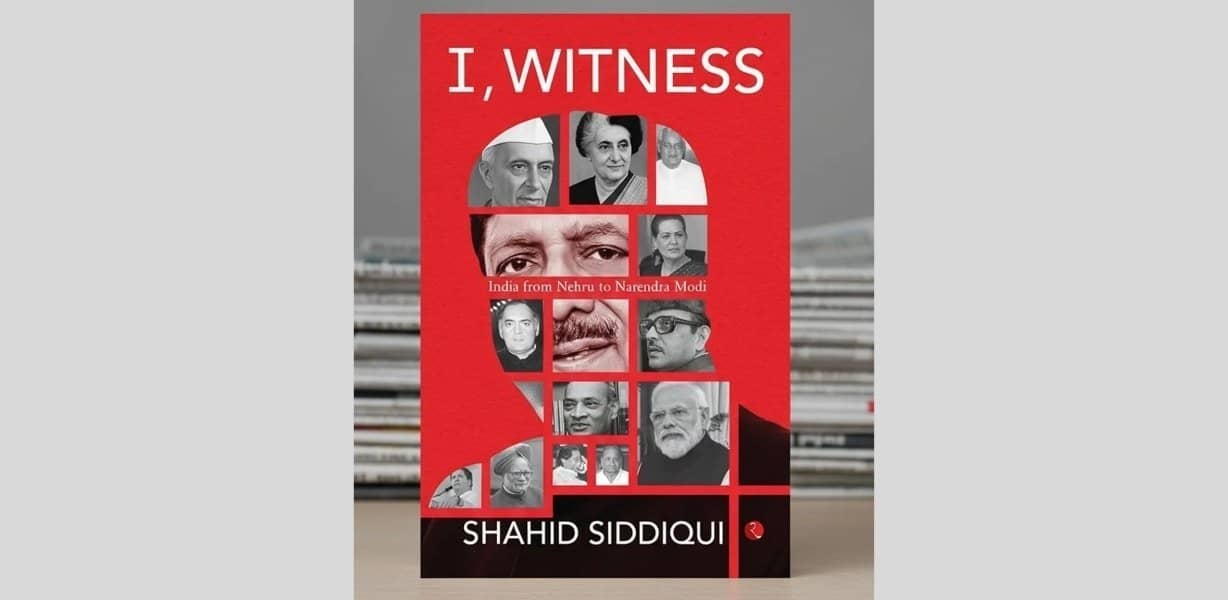
I Witness: India’s journey through the decades, from Nehru to Narendra Modi
Key Takeaways
1 of 3
Automatically generated. Read full article for complete context.
The title of Shahid Siddiqui’s memoir, “I, Witness”, appears deceptively simple, yet it carries a layered and resonant meaning. It is not merely a declaration of the author’s presence or a play on his name, Shaid, meaning witness; it is a moral assertion. Siddiqui positions himself as a chronicler of his times, one who has borne witness to cruelty and injustice, prejudice and political convulsions, as well as the slow but profound social transformations of the age. The book distils decades of journalistic engagement, keen social observation, and intellectual restlessness. Interwoven within it are personal recollections, analyses of national events, and the muted yet persistent anguish of minority existence.
There was a time when Nai Dunya stood as the most widely read Urdu weekly in the country. Its editor, Shahid Siddiqui, belongs to a small and distinguished group of Indian Urdu journalists who had direct access to the corridors of power and the opportunity to engage personally with the nation’s most influential figures. He remains the only Urdu journalist to have interviewed Narendra Modi during his tenure as Chief Minister of Gujarat. Siddiqui also served as a member of the Rajya Sabha and was, at different points, associated with the Congress, the Samajwadi Party, and the Bahujan Samaj Party. He is the son of the late journalist Abdul Waheed Siddiqui. After completing his MA in Political Science in 1974, he went on to teach for many years as a lecturer at Deshbandhu College, Delhi University.
A substantial portion of the book is devoted to a searching examination of the political, social, and psychological condition of Muslims in post-Partition India. Siddiqui insists, with quiet firmness, that Indian Muslims are neither outsiders nor temporary guests. They belong to the same soil and are heirs to the same civilizational legacy, yet they are compelled, time and again, to prove their loyalty. In reflecting on the collective experience of Indian Muslims, he neither indulges in romantic nostalgia nor confines himself to plaintive lamentation. Events such as the demolition of the Babri Masjid, the Gujarat communal riots of 2002, and the steady rise of Islamophobia in recent years are presented not as isolated ruptures, but as part of a continuous psychological and social process, one that has steadily pushed Muslims to the margins of public life.
While the book surveys the political landscape from Independence onward, the Emergency imposed by Indira Gandhi and the subsequent period of Rajiv Gandhi’s rule receive particularly close scrutiny. Sanjay Gandhi, the most visible face of the Emergency, became a lightning rod for public anger owing to his conduct. His abrasive methods and unbridled thirst for power played a major role in the formation of Indira’s authoritarian image. The episodes of mass forced sterilization carried out under his influence stand as a blot on the conscience of any civilized society. Even in a meeting with Shahid Siddiqui after the Emergency, Sanjay Gandhi refused to budge from his position, maintaining that a systematic campaign of propaganda had been unleashed against him, which turned public opinion hostile. Siddiqui found this defence unconvincing, for he himself and his newspaper, had suffered firsthand the rigors and repression of the Emergency.
Yet Siddiqui’s habit of weighing both sides of the scale prevents him from offering a one-dimensional portrait. He also records those aspects of Sanjay Gandhi’s personality that are often glossed over. Sanjay was a patient listener, given to long silences. He was sparing with words, but when he spoke, he did so plainly and without equivocation. He possessed a clarity of thought and a stubborn resolve in pursuing his objectives. An avid pilot, he flew daily to indulge his passion. On the morning of June 30, 1980, he took off in his small aircraft, only to crash shortly thereafter and lose his life. According to his close associate Akbar Ahmed Dumpy, the aircraft had been gifted to Sanjay by Dhirendra Brahmachari. Dumpy harboured the suspicion that the crash was an act of sabotage, allegedly orchestrated by the Soviet intelligence agency, KGB. It was motivated by Sanjay’s efforts to persuade Indira Gandhi to loosen her ties with the Soviet Union and pivot closer to the United States.
After Sanjay’s death, Indira Gandhi was never quite the same again. Bereft and vulnerable, she found herself surrounded by a coterie of conspiratorial minds. In this altered landscape, Arun Nehru rose to wield extraordinary influence. Operating largely from the shadows, he played a high-stakes game in Indian politics over the next several years, the toxic aftereffects of which the country continues to endure even today. Traditionally, the Congress had avoided adopting an overtly communal posture; yet, according to the author, during Arun Nehru’s ascendancy it appeared more overtly pro-Hindu than even the erstwhile Jana Sangh.
Arun Nehru’s hand is seen as instrumental in the worsening of the situations in Kashmir and Punjab. The author quotes senior Congress leader H. K. L. Bhagat as saying, “Arun believes that the fires of Kashmir and Punjab should be allowed to blaze; once they rage, we will douse and win the nation’s heart.” In October 1984, Indira Gandhi was assassinated by her Sikh security men. A few weeks earlier, Inder Kumar Gujral, who would later serve briefly as Prime Minister, had visited the author’s father and confided that Arun Nehru and his close associates, Zail Singh and Buta Singh, had gravely misled the Prime Minister about the ground realities in Punjab. To the Sikh community, the Army’s Operation Blue Star at the Harmandir Sahib was perceived as a direct assault on the Akal Takht. The shock ran deep. In the aftermath of Indira Gandhi’s assassination, anti-Sikh pogroms erupted, and the author discerns behind them the same calculating mind of Arun Nehru. Rajiv Gandhi, disinclined by temperament toward politics, was nonetheless compelled to step into this treacherous morass.
Shahid Siddiqui offers a detailed and incisive analysis of the Shah Bano case. Muslim leadership took the issue to the streets; massive rallies were organized, and processions swept across the country. In Parliament, Arif Mohammad Khan spoke forcefully in support of the Supreme Court’s verdict, defying prevailing Muslim public sentiment, a stance that brought him national attention. Both Sangh Parivar as well as the left liberals showered praise on him. Thus, an impression spread widely that Arif had the total support of PM Rajiv Gandhi on this issue. But this triggered deep unease among Muslim leaders within the Congress. Minister Ziaur Rehman Ansari met Rajiv Gandhi to convey the community’s anger and anguish. The issue sent tremors through the political landscape. Eventually, in 1986, Parliament enacted the Muslim Women (Protection of Rights on Divorce) Act, which effectively overturned the Supreme Court’s ruling. The BJP seized this moment to widen the communal chasm.
Meanwhile, another political drama was unfolding behind the scenes. Backed by President Zail Singh, Arun Nehru harboured ambitions of occupying the prime ministerial chair himself. Rajiv Gandhi, however, gradually sidelined him. A change of tack followed. Arun Nehru began meeting the leaders of Vishwa Hindu Parishad, which was spearheading the Ram Janmabhoomi movement. It was a kind of tacit support. In the name of balancing the legislation perceived as appeasing Muslims, the locks of the Babri Masjid were opened and the way for ritual worship was cleared. Officially, this was done on the orders of the Faizabad District Magistrate, but few doubted how swiftly and smoothly such an order could be executed, complete with television cameras, in a matter of hours.
The most striking feature of Shahid Siddiqui’s writing is his gift for storytelling. He does not present events as bare reportage; instead, he situates them within a rich tapestry of context, character, and historical moment. His prose carries an air of candour and self-assurance. He appears neither overawed by power nor overly anxious to conceal his proximity to it. This frankness lends his writing a certain force, but it also leaves room for skepticism. Siddiqui is undeniably a controversial figure, yet his words carry weight. He embodies an era of Urdu journalism in which the editor did not merely report events but announced self presence through them. His life, journalism, and politics are so tightly interwoven that they resist neat separation. This very entanglement is both his defining trait and the chief source of criticism against him. I, Witness thus stands as a document that reads with the ease of a compelling narrative, even as it bears the gravity of lived history.
Disclaimer:The views and opinions expressed in this article are those of the author(s) and do not necessarily reflect the official policy or position of The Rift.
*Book ReviewBabri MasjidEmergencyMemoir ReviewMuslim ExperienceShah Bano CaseShahid SiddiquiUrdu Journalism