Opening The Rift
therift
© 2026 The Rift. All Rights Reserved.
Critique of Popular Misconceptions Regarding Paradise and Intoxicants in Islam
Distorting allegories into a tale of male hedonism is an aberration that strays from Quranic emphasis on purity, balance, and divine justice.

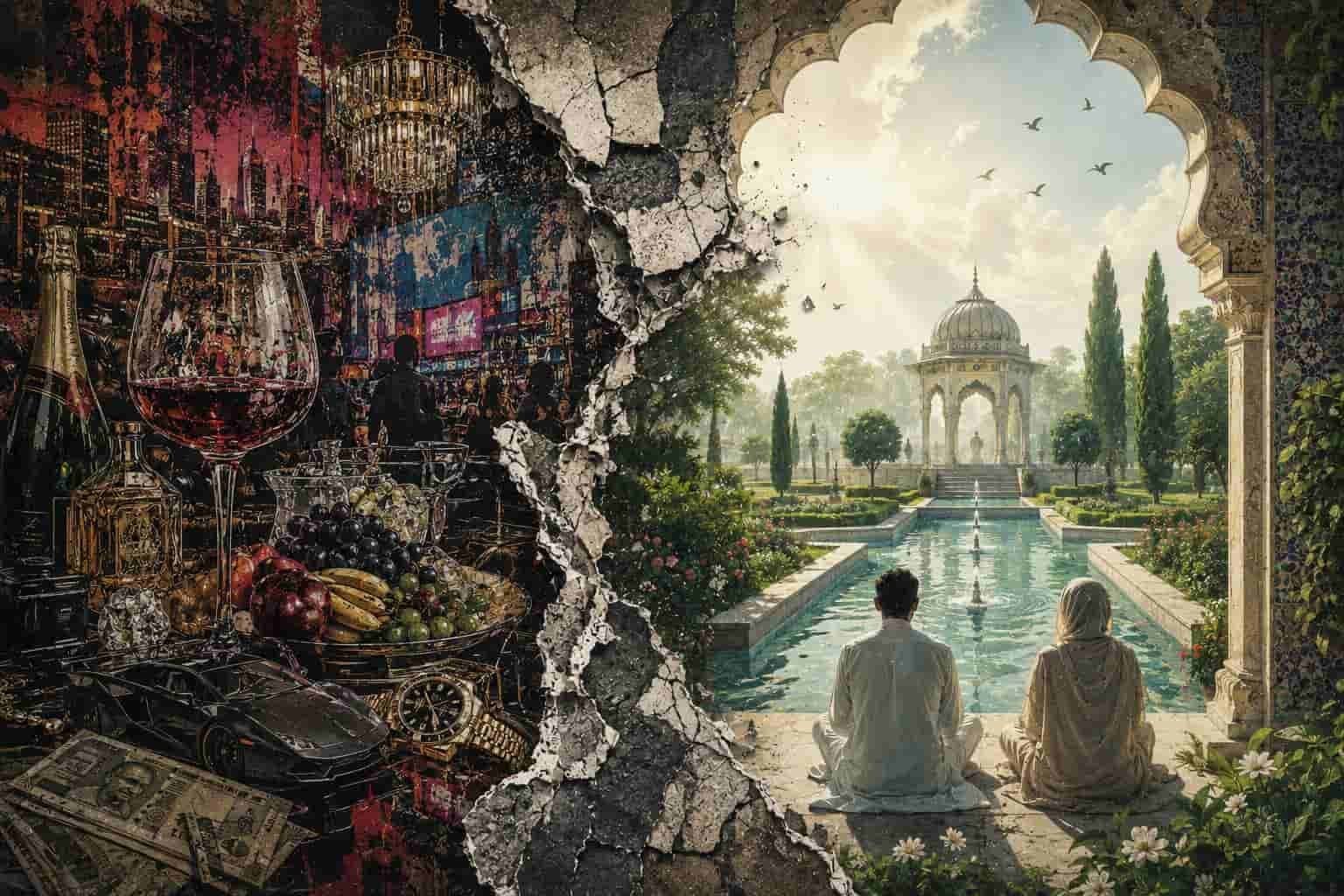
Islamic principles on paradise and intoxicants, debunking popular misconceptions (Representative Image)
Key Takeaways
1 of 3
Automatically generated. Read full article for complete context.
The viral clip features a television debate where a woman critiques a cleric’s portrayal of Paradise (Jannah), arguing that the popular imagery, revolving around material indulgences like flowing wine, dozens of maidens (hoor), and physical pleasures reserved for men, resembles a hedonistic den (aiyashi ka adda) rather than a spiritual sanctuary.
When she questions what reward exists for righteous women, the cleric responds that a woman will simply be the “leader” over those 72 maidens while remaining with her earthly husband. When pressed further on whether this is fair, the cleric deflects responsibility, claiming the question should be asked to God.
This exchange highlights a widespread issue: the conflation of literalist, sensationalized folk interpretations with actual Quranic theology.
The rhetoric offered by such preachers distorts primary Islamic sources, transforming allegorical descriptions of spiritual bliss into crude physical indulgences.
The Etymology and Linguistic Distinctions: Sharab vs. Worldly Intoxicants
A primary point of confusion stems from the linguistic shift between classical Quranic Arabic and modern South Asian languages (Urdu/Hindi).
Arabic: شَرَاب (Sharāb) = Any liquid / drink (Water, Milk, Honey, Juice)
Urdu/Hindi: شراب / शराब = Specifically Alcoholic Intoxicants
The Arabic Root
In Classical Arabic, the word شَرَاب (Sharāb) is derived from the root sh-r-b, which simply means “to drink.” In the Quran, sharāb denotes any drinkable liquid.
For instance, in Surah An-Nahl (16:69), honey issuing from bees is described as a “drink (sharāb) of varying colors, in which there is healing for people.”
The ultimate drink of Paradise is termed شَرَابًا طَهُورًا (Sharāban Ṭahūrā) in Surah Al-Insan / Ad-Dahr (76:21), meaning a “pure, purifying drink.”
The Quranic Term for Alcohol : Khamr
When the Quran addresses worldly, intoxicating alcohol, it uses the term خَمْر (Khamr), derived from the root meaning “to veil or cover” (referring to the veiling of the intellect).
Quranic Chronology and the Nature of Heavenly Drinks
The Quranic prohibition of alcoholic intoxicants on Earth (khamr) occurred gradually in four distinct stages across Madani surahs :
Stage : Revelation : Quranic Reference : Ruling / Purpose
- 1st Early Madani Surah Al-Baqarah (2:219) Notes that intoxicants contain great sin and some benefit, but the sin outweighs the benefit.
- 2nd Mid Madani Surah An-Nisa (4:43) Prohibits approaching prayer (Salah) while in a state of intoxication.
- 3rd Late Madani Surah Al-Ma’idah (5:90–91) Absolute, final prohibition (Haram), classifying khamr as a defilement and work of Satan.
Contrast with the “Wine” of Paradise
When the Quran mentions rivers of “wine” (khamr) or cups (ka’s) in Paradise (e.g., Surah Muhammad 47:15, Surah As-Saffat 37:45–47), it explicitly strips the substance of all qualities associated with earthly alcohol :
“There will neither be any harm/headache (ghawl) in it, nor will they be intoxicated thereby.”
— Surah As-Saffat (37:47)
“From which they will have no headache, nor will they be intoxicated.”
— Surah Al-Waqi’ah (56:19)
Quranic exegesis (Tafsir) confirms that heavenly drinks are non-intoxicating, wholesome beverages symbolic of pure delight, lacking the foul odor, loss of reason, or physical harm of worldly alcohol.
Comparing Sharāban Ṭahūrā or heavenly khamr to earthly alcohol is a fundamental misunderstanding of Quranic imagery.
Deconstructing the Narrative Around Hoor and Gender Equity
The preacher’s claim that men are granted “72 maidens” while women receive no equivalent personal reward is a trope born of literalist folk preaching rather than sound Quranic principles.
The Term Hoor in Quranic Linguistics
The word حُور (Ḥūr) is the plural of both Aḥwar (masculine) and Ḥawrā (feminine).
Linguistically, it denotes companions with pure, starkly contrasting, luminous eyes, signifying purity and intense beauty.
Gender Neutrality :
Classical commentators (such as Muhammad Asad and Allama Iqbal’s contemporaries) note that ḥūr is grammatically an adjective applied to pure companions without being restricted exclusively to females.
Modesty and Privacy :
The Quran describes these companions as قَاصِرَاتُ الطَّرْفِ (Qāṣirāt ut-Tarf), meaning “those who restrain their gaze” (Surah As-Saffat 37:48, Surah Ar-Rahman 55:56), symbolizing mutual devotion and modesty rather than objectification.
The “72” Figure: The number 72 does not appear anywhere in the Quran.
It originates from specific weak (za’iif) or allegorical Hadith reports that were often popularized by public storytellers (Qussas) to stir emotion among early Bedouin audiences.
Absolute Spiritual and Reward Parity in the Quran
The Quran explicitly establishes complete gender equality regarding moral agency and ultimate divine reward :
“Whoever does righteousness, whether male or female, while being a believer : We will surely cause them to live a good life, and We will surely give them their reward according to the best of what they used to do.”
— Surah An-Nahl (16:97)
“Therein you shall have all that your inner-selves desire, and therein you shall have all for which you ask.”
— Surah Fussilat (41:31)
The notion that women in Paradise are relegated to a passive or undesirable existence contradicts Surah Fussilat (41:31), which promises that every soul, male or female, will be granted whatever they desire, free from earthly resentment, forced relationships, or discomfort.
The host’s laughter in the video reflects a natural reaction to a caricature of religion.
When clerics reduce the spiritual reality of Jannah to physical excess, they misrepresent Islamic theology.
The Quran uses physical metaphors, gardens, shade, pure streams, fine garments, and refined companionship, to convey concepts of ultimate peace, joy, and spiritual fulfillment to human minds constrained by earthly language.
Distorting these allegories into a tale of male hedonism is an aberration that strays from the Quranic emphasis on purity, balance, and absolute divine justice.
Disclaimer:The views and opinions expressed in this article are those of the author(s) and do not necessarily reflect the official policy or position of The Rift.
*Islamic TheologyGender Equality in IslamHoorJannahKhamrParadiseQuranic InterpretationSouth Asian Islam