Opening The Rift
therift
© 2026 The Rift. All Rights Reserved.
Sant Kabir’s Enduring Message of Love, Non-Violence, Truth, Simplicity and Devotion
Over five centuries after he confronted the most powerful pillars of establishment with truth and courage, Sant Kabir reigns in the hearts of millions of people as an uncompromising social reformer and people’s poet.

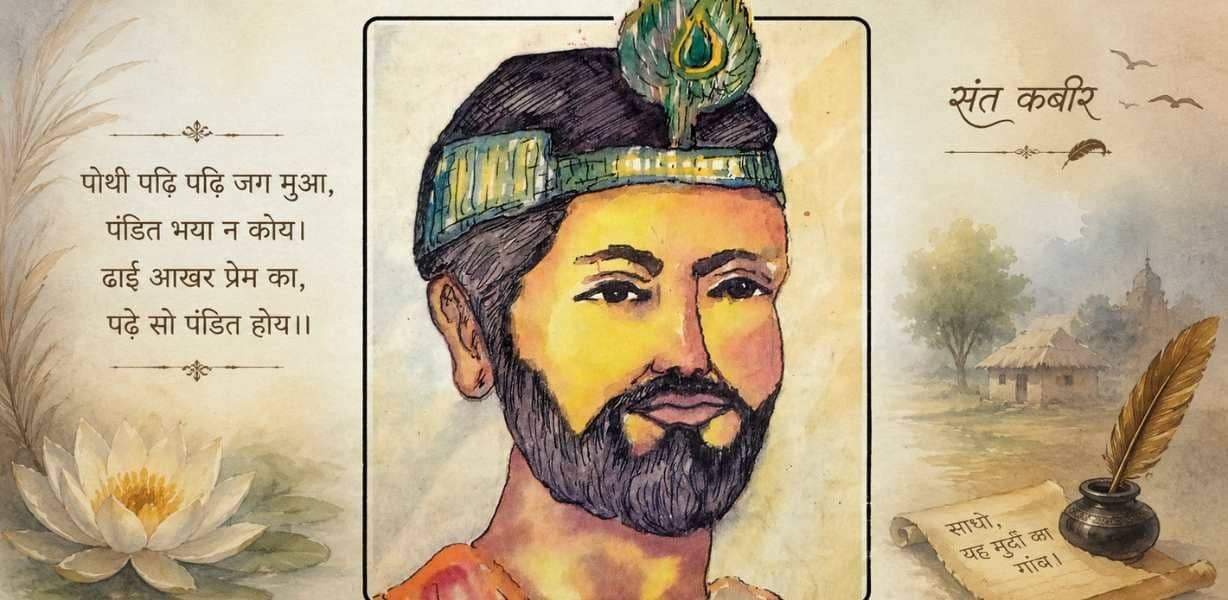
Sketch by Surabhi.
Key Takeaways
1 of 3
Automatically generated. Read full article for complete context.
Sant Kabir was a great social reformer, spontaneous poet, working-class weaverJulaha CommunityKabir belonged to the Julaha community of weavers, a working-class artisanal group historically engaged in textile production., activist mobilizer and people’s philosopher all combined into one, with various roles merging seamlessly without any effort. He lived in India in or around the 15th century, spending by far the greater part of his life in the city of VaranasiVaranasiAn ancient city in northern India, considered a major spiritual and cultural center.. He made a great impact on people in his lifetime, and this impact continues to be seen in India over five centuries later, with millions quoting him in daily life and declaring themselves to be his followers, more or less. He and his family lived for most of their life in great economic difficulties, but this did not deter Kabir from his social commitments and involvements. He was also one of the most courageous persons ever, and this courage manifested itself day after day for years in his fearless social criticisms.
His essential and enduring message is that of universal love, seeking of truth and remaining committed to truth, leading a family life based on simplicity, maintaining a firm commitment of non-violence towards all forms of life and finding bliss in devotion and closeness to God. In his verses he rejects all hypocrisy and instead places the most emphasis on truth, non-violence and love. The good life consists of seeking truth and then living life on this basis. If the truth for one is based on loving all without any discrimination or in being kind to all forms of life or in justice based life and simple life based on limited needs, then one must follow this truth and life based on this. One walking on the path of truth is close to God and what more can anyone want, what higher bliss or protection or happiness does one need?
The Pillars of Kabir’s Philosophy
Universal Love
A rejection of hypocrisy in favor of boundless compassion without discrimination.
Non-Violence
A firm commitment to kindness and avoiding cruelty towards all forms of life.
Simplicity
Favoring limited needs and a working-class lifestyle over the exaggerated pursuit of consumption.
Truth
Seeking and remaining committed to truth, even when facing powerful pillars of the establishment.
VISUALS BY THE RIFT
While emphasizing this, it is important to also note that Sant Kabir rejected all rituals and exaggerated formal practices associated with various religions. If these practices involved any cruelty, then he even condemned these in strong words. At other times he mocked at the non-rationality and meaninglessness of various rituals and exaggerated practices without fear or favor. In fact he even mocked too much importance being given to formal scholarship or mere book knowledge if this was devoid of human and ethical concerns. Sant Kabir was particularly critical of arrogance or arrogant exercise of power related to such exaggerated exhibition of so-called religiosity and scholarship.
At the same time he was also critical of those who needlessly made a display of renouncing the world or proclaiming themselves to have obtained some greatness based on this. Instead Kabir favored simplicity of life as seen in the life of working class people and their families. What is truly valuable is a life based on ethics, good conduct and rightfulness, living in ways which are helpful to others and never intentionally harmful for others, in which careful decisions are made in thoughtful ways to ensure this. A life based on helping and care for others is not at all burdensome as this brings a person closer to bliss.
Seen in this way, common talk like that of hell or heaven is useless, as the main issue is that of living an ethical life that is helpful for all on the basis of its rationality (not out of any fear of hell or desire of heaven). Differences between the outer rituals and practices of various religions are not important or relevant as the basic truths remain the same. Much more important is the equality of all people and love among all people. What narrow-minded followers of various religions or sects identify as holy or unholy is generally not relevant or of great significance.
What narrow-minded followers of various religions or sects identify as holy or unholy is generally not relevant or of great significance.
The person who follows the path of ethics and truth will also need determination and courage. This courage and firmness is gained on the basis of devotion to God and closeness to God as this also gives strength to bear and overcome many difficulties without wavering from convictions based on the understanding of the right conduct.
The satisfaction one gets from leading the right life as well as the bliss from the closeness to God makes this a life of great happiness, which can be experienced even in the middle of the difficulties of daily life. To be truly close to God it is not essential to go to a place of worship or to go on a pilgrimage, as God resides within all of us and so we can find God within us by always leading the life of right conduct and thereby maintaining the moral strength of feeling closeness to God.
Over five centuries after he confronted the most powerful pillars of establishment with truth and courage, Sant Kabir reigns in the hearts of millions of people as an uncompromising social reformer and people’s poet. He is still arguably the most commonly quoted poet in the vast Hindi belt, with a following that extends much beyond it.
Over five centuries after he confronted the most powerful pillars of establishment with truth and courage, Sant Kabir reigns in the hearts of millions of people as an uncompromising social reformer and people’s poet.
The weaver poet with all his fierce messages against the powerful establishment has managed to establish such wide popularity that even those powerful forces whom he opposed very openly find it difficult to speak openly against him, while those who believe in him often find it easier to convey such anti-establishment feelings by quoting him rather than speaking directly.
In those times the tendency to mix myth, miracle and legend with reality was such that there are some difficulties in studying Sant Kabir and his poetry. Add to this the fact that Kabir and his friends went by the oral traditionOral TraditionCultural material and tradition transmitted orally from one generation to another, often through poetry, songs, or folktales. and the first efforts to write down his verse were probably made around a hundred years after he breathed his last. By that time some of his precious verse may have been lost while something extra may even be added by followers and others not necessarily understanding him properly. This increases difficulties of the careful researcher. Rabindranath TagoreRabindranath TagoreA Bengali polymath, poet, and Nobel laureate who reshaped Bengali literature and music, and actively translated Kabir’s works. who spent a lot of his time translating about 100 poems of Kabir later had to live with critics who questioned that several of these poems were not of Kabir really!
So we must go to the essence of the great poet and thinker and not be distracted by critics who pick on a few quotes attributed to him for criticism. In fact these few scattered quotes go against the essence of his personality and message, and in all likelihood were never spoken by him, or were twisted out of context.
So let us concentrate on the essence of Kabir.
- The first and foremost aspect of the life of Kabir was that he was a relentless seeker of truth. He clearly saw false values pervading all around him in society, promoted by powerful people, and he exposed and criticized these all the time. But this for him was not adequate. If all this was false, then what is the truth, where is the truth?
- All his life Kabir was a deep and free thinker, thinking about basic aspects of the world around him in a very free way. Nothing was too well-entrenched and too holy to be taken for granted. This came naturally to him, but what is important is that he cherished and protected this very important aspect of his personality all his life in the middle of many problems of daily life.
- Kabir was one of the most courageous persons of all times. When all his thinking led to understanding of deeper truths which could be very unpalatable to very powerful sections of society, he never hesitated to speak out, despite being warned time and again regarding this.
- However a very important aspect of his endless, great courage was that it was never used for violence against others but always for peace and for peaceful resistance against injustice and social ills.
- Kabir recognized the reality that his courage in opposing powerful forces would result in his persecution and was willing to face it. Time and again he faced this with quiet determination, despite being distressed.
- The increasing difficulties instead of distracting him took him towards even deeper realization of truth, as in pain and distress he had to engage in even deeper search for solace and support within him.
- He was capable of very original thinking with an exceptional talent for going to the heart of the matter while ignoring the frivolous or less important aspects. He was able to rise above all narrow and often frivolous debates of his times, based on sects and religions, and focus on the most basic issues.
- He was a working class reformer and poet. He continued to earn his living from working as a weaver. Most of his colleagues, friends and followers, also from working and artisan class, continued to do so.
- Poetry came naturally to Kabir and he said his verse in the spoken dialect of his people, never introducing any artificiality in his language and style. Often his verse was in harmony with the tune of the loom on which he was weaving cloth. One of the reasons why it could become so popular and was remembered easily by people was that it came so easily to lips for singing and humming.
Now let us look at the essential message of Kabir.
- The most essential task in human life is to live a life which is in harmony with the well-being and welfare of others, including other people and other forms of life.
- One should be compassionate to all forms of life. All cruelty to all animals must be avoided.
- Life should be simple and based on few needs. This saves our energy and efforts for pursuing the higher purpose of life and serving those who need us more. Excessive pursuit of consumption and luxuries takes us away from the real purpose of life. Intoxicants (liquor, opium etc.) should be entirely avoided. The egoistic tendencies of a person are harmful and should be got rid of.
- We should never be afraid to speak and act against injustice and wrong-doing.
- As there is so much injustice and so many false values, and as powerful persons benefit from this and perpetuate this system, great courage is often needed to check injustice and protect the weak.
- A righteous life or life of right conduct or ethical conduct is the real need. Rituals are not necessary at all and are often harmful or silly distractions on which time and effort should not be wasted. Rituals stand in the way of realization of true spirituality.
- The goodness of God is present in all living beings and so one should serve God not by empty rituals but by reducing the distress of all living beings, particularly those who need our help.
- To get the strength and courage of living the right life, one should seek to realize the God within us, the God in our hearts, the truth in our hearts, and this is where we get support and solace for our right living, no matter how many difficulties there may be in such a path.
- It is not at all necessary to renounce family or working life for this, one can realize this righteousness of life and closeness to God while continuing one’s livelihood and family life, as long as care is taken to avoid various distractions and wrong-doings.
- While God within us is most precious, it is a blessing also to get a good
teacher who helps in the realization of God and truth within us.
These are the essential and durable messages of Sant Kabir, as reflected in his life as in his poetry. His poetry is one of the greatest examples of stating the essential truths of life in down to earth ways. He raised questions regarding false values in such ways, and by using very obvious symbols, that even his opponents and enemies were left speechless. He was a great communicator who used verse that could be sung easily and naturally.
Disclaimer:The views and opinions expressed in this article are those of the author(s) and do not necessarily reflect the official policy or position of The Rift.