Opening The Rift
therift
© 2026 The Rift. All Rights Reserved.
Shibaji in Barasat
We used to argue about the Idea of India. Now we argue about the proximity of a chicken leg to a temple wall.

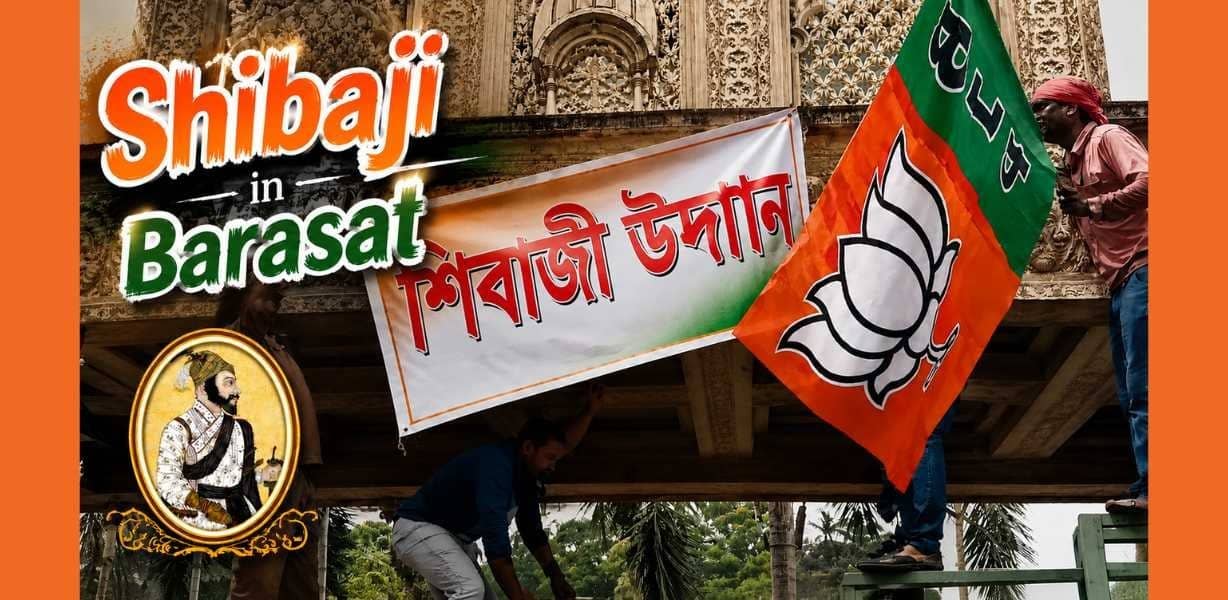
Source: altnews
Key Takeaways
1 of 3
Automatically generated. Read full article for complete context.
In Barasat’s Noapara area, the “common people” have discovered a new form of urban planning. It doesn’t involve sewage maps or traffic flow. It involves a calculator and a very long ladder.
On May 5, a group of youths scaled a decorative arch on Masjid Bari Road, broke off the lettering, and replaced it with a sign reading Netajipally. The logic, as explained by a BJP supporter to a Zee 24 Ghanta reporter, was beautifully simple: “How many booths do Muslims have there? Two. Will a road be named Masjidbari Road for two booths?”
A few kilometers away, Siraj Udyan, a park named after the last independent Nawab of Bengal was undergoing a similar rebranding exercise. It is now Shibaji Udyan. The justification was simple and innocent; “No one named Nawab Sirajudaulla or Siraj has ever come to Barasat.”
The reporter, in a rare moment of professional restraint, did not ask if Chhatrapati Shivaji Maharaj had ever stopped by Barasat for a snack.
Mainstream media is currently processing this as ‘post-poll violence’, a catch-all term for the ritualistic broken windows and bloody noses that follows after each election in Bengal. But what’s happening in Bengal now isn’t just violence, it’s a Geographical Performance Review with a majoritarian flavor.
The road sign is no longer a navigation tool. It is a reward. The neighborhood is no longer a community, it is a series of demographic balance sheets. If your booth didn’t deliver the right numbers, your road loses its name, your park loses its history, and your biryani shop loses its lease.
After winning his seat, Suvendu Adhikari didn’t talk about development or the state’s debt-to-GDP ratio. He spoke in the language of the ledger: “Nandigram ka Hindu janta phir mujhe jitaya. Waha musalmaan vote pura ka pura TMC ko mila.”
His conclusion? “I will work for the Hindus.”
This is the privatization of governance. In this model, the state is not a provider of public goods, it is a vending machine that only accepts specific coins. If you didn’t drop the right coin into the slot, the machine doesn’t just stop working, it calls a bulldozer.
Across Bengal, documented by Alt News, the infrastructure of this new logic is visible. In Bongaon, saffron-clad workers approached a biryani shop next to a temple and asked it to move. Why? Because “If we did this outside a mosque, you would feel bad too.” It’s the logic of the kindergarten playground applied to the constitutional right to trade.
In Murshidabad, the Lalbagh Eidgah was vandalized. In Kolkata’s New Market, a bulldozer razed a TMC office while police and CRPF personnel stood by, presumably admiring the mechanical efficiency of the bucket.
Bhisham Sahni, in his novel famous Tamas, captured this process eight decades ago. He showed that communal violence is never just a clash of emotions. It has a supply chain. A dead pig at a mosque, a dead cow at a temple, someone always has to deliver the carcass. In 2026, the carcass is the Election data. The supply chain has moved from the slaughterhouse to the smartphone. The trigger is no longer a dead animal, it is the realization that Booth No. 5 didn’t vote for us. That data point is the carcass, it is the justification needed for the ladder, the hammer, and the new Netajipally sign. We have moved from the spontaneous riots of the past to the calculated audit of a neighborhood’s right to exist under its own name.
The Bengali bhadralok, who spent the last month tweeting about the cultural soul of Bengal while ignoring that their own neighborhoods were already a series of invisible walls.
The TMC, now crying nightmare over the biryani shop, spent a decade building a ‘party office culture’ where the local office was the only court, the only police station, and the only employment exchange. They didn’t build institutions, they built territories. The BJP hasn’t changed the game, they’ve just changed the jersey color with better understanding of target recognition by cloths and brought bulldozers to destroy that target.
What happens when the street you live on is a ledger?
When road names are tied to booth counts, every election becomes an existential threat to the map. We are moving toward a future where you don’t just lose an election, you lose your address. The territorialization of the neighborhood means that Sonar Bangla isn’t a vision for the state, it’s a threat to anyone who doesn’t fit the demographic math of the winning side.
In the video from Bongaon, the worker at the biryani shop looks at the crowd with a mix of confusion and resignation. He’s being told his shop is a provocation.
We used to argue about the Idea of India. Now we argue about the proximity of a chicken leg to a temple wall.
The question isn’t whether the BJP will build Sonar Bangla. The question is what does Sonar Bangla actually taste like when the only thing left on the menu is majoritarian insecurity and a very loud bulldozer?
Disclaimer:The views and opinions expressed in this article are those of the author(s) and do not necessarily reflect the official policy or position of The Rift.