Opening The Rift
therift
© 2026 The Rift. All Rights Reserved.
Compulsory Conformity, Judicial Realignment, a Gagged Press and Institutional Metamorphosis
The judiciary’s willingness to normalize mandatory state rituals reflects an internal alignment with state-led cultural homogenization.


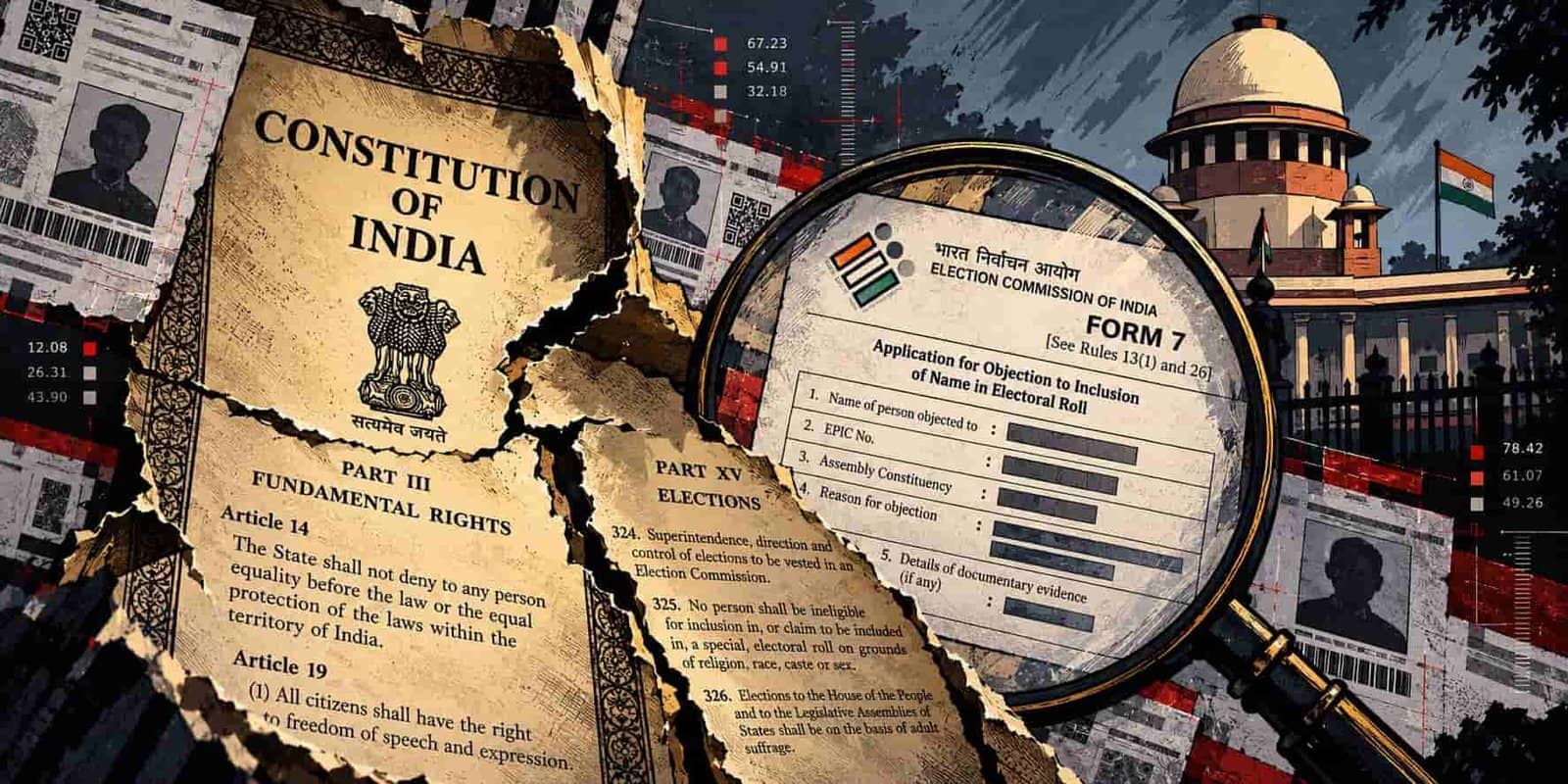
Representative image
Key Takeaways
1 of 3
Automatically generated. Read full article for complete context.
We did not get the full picture of the legal and political implications when Justice Raghuram of the then Andhra Pradesh & Telangana High Court asked a rhetorical question. Now, we are facing the answer. What was the question? “What do you expect when you appoint a virus the head of a pharmaceutical company?” Read that again. Let that sink in.
Recent judicial proceedings, most recently visibly exemplified by the Calcutta High Court’s oral observations regarding the compulsory recitation of all six stanzas of Vande Mataram in state-recognised madrasas, signal a profound realignment within Indian constitutional jurisprudence.
Downplaying minority religious objections with dismissive rhetoric like “heavens will not fall” reflects more than an isolated lapse in judicial restraint; it underscores a structural shift where judges increasingly internalize executive majoritarianism and ground their reasoning in theological conformity rather than constitutional morality.
This institutional drift is exacerbated when judicial functionaries attempt to censor or restrict media reporting of open-court exchanges.
By contrasting modern majoritarian tendencies with the landmark precedent of Bijoe Emmanuel v. State of Kerala (1986), this article demonstrates how the simultaneous erosion of religious freedom under Article 25 and press freedom under Article 19(1)(a) undermines the judiciary’s role as a counter-majoritarian guardian, replacing constitutional democracy with enforced majoritarian hegemony.
The Shift : Counter Majoritarianism to State Alignment
The Indian Constitution was designed as a counter-majoritarian instrument, structured to protect individual liberty, freedom of conscience, and minority rights against the shifting tides of majoritarian politics.
Articles 19(1)(a) (freedom of speech and expression, encompassing both the right to report and the right to remain silent) and 25(1) (freedom of conscience and the right freely to profess, practice, and propagate religion) constitute the pillars of this architecture.
However, modern judicial practice reveals an increasing alignment between the bench and executive priorities.
During the hearing of a Public Interest Litigation challenging state directives that make all six stanzas of Vande Mataram mandatory in West Bengal madrasas, the court remarked: “If I am asked to repeat a quote which is not in my religion, what happens? Do I become a person not belonging to my religion?”
Such observations trivialize the burden that state-enforced religious or quasi-religious rituals place on minority conscience.
By drawing a false equivalence between voluntary attendance at private denominational institutions and state-mandated ritual compliance in minority-run madrasas, the judiciary shifts from testing state action against constitutional standards to enforcing compliance with state-backed cultural mandates.
The Constitutional Baseline : Bijoe Emmanuel v. State of Kerala (1986)
To understand the degree of this departure, one must revisit Bijoe Emmanuel v. State of Kerala (1986 3 SCC 615), authored by Justice O. Chinnappa Reddy.
In Bijoe Emmanuel, three Jehovah’s Witness children were expelled from school for declining to sing the National Anthem (Jana Gana Mana). They stood up respectfully during the assembly but refrained from singing because their religious doctrine forbade giving divine praise to any entity other than God.
The Supreme Court upheld the right to refrain, establishing three core tenets :
The Right to Silence : Freedom of speech and expression under Article 19(1)(a) inherently guarantees the right to remain silent. Compelling an individual to speak or sing constitutes an impermissible restriction unless backed by a valid law meeting the narrow grounds under Article 19(2).
Autonomy of Conscience under Article 25 : Justice Chinnappa Reddy affirmed that courts are not competent arbiters of the correctness or rationality of a genuinely held religious belief. If a practice does not threaten public order, morality, or health, Article 25 protects the citizen’s right to adhere to it.
Constitutional Tolerance as a Mandate : The Court emphasized :
“Our tradition teaches tolerance; our philosophy preaches tolerance; our Constitution practices tolerance; let us not dilute it.”
Applying Bijoe Emmanuel to the Vande Mataram controversy highlights crucial legal contradictions :
Anthem versus Song : While Jana Gana Mana is the official National Anthem governed by statutory norms, Vande Mataram holds status as the National Song. Its full text contains explicit religious imagery, addressing the nation as divine Hindu deities like Durga, Lakshmi, and Saraswati, that conflicts directly with Islamic monotheism (Tawheed).
Negative Liberty : Forcing students to recite verses that contradict their faith violates negative liberty. Denying this protection undermines the foundational principle established in Bijoe Emmanuel.
The Bench as a Portal : Theological Inquiries and Moral Coercion
While oral exchanges during hearings do not constitute the binding ratio decidendi of a written judgment, legal scholars treat court dialogue as a critical indicator of judicial philosophy. These proceedings reveal the unstated assumptions and normative shifts that shape judicial outcomes. Compiled together they give you a mind map of the trend of judicial thinking and the degree to which it normalises state erosion of constitutional guarantees and compels compliance with unconstitutional impositions.
Displacing Constitutional Morality with Theological Arbitrage :
Constitutional morality requires judges to apply principles of equality, liberty, and secular autonomy rather than personal or majoritarian moral codes. When a court queries whether reciting a non-Islamic verse strips a Muslim of their faith, it abandons constitutional analysis for theological judgment.
The court assumes the authority to define what should or should not offend a believer’s conscience, substituting judicial theology for constitutional guarantees.
Normalizing State Assimilationism Through Informal Rhetoric : Off-the-cuff remarks dismissing constitutional resistance as minor (“heavens will not fall”) set a deeply regrettable narrative baseline that de-legitimizes rights claims. This rhetoric signals that majoritarian cultural conformity is the default expectation, while asserting fundamental rights under Article 25 is treated as unnecessary disruption.
When the Guardian Champions Gagging the Press : The Paradox of Institutional Credibility
This tendency to enforce state narratives is inextricably linked to efforts by judicial leaders to restrict media coverage of open court proceedings. When the head of a nation’s judiciary advocates for restrictions or gag orders on reporting oral exchanges, it creates a fundamental paradox within a constitutional democracy.
1 The Erosion of Moral Authority and Institutional Legitimacy
A constitutional court possesses neither the power of the purse nor the sword; its authority depends entirely on public trust and moral legitimacy. When the leadership of the judiciary attempts to insulate its own oral observations from media scrutiny, the consequences are far-reaching :
Chilling Effect Across the Legal System : Shielding judicial speech signals to lower courts, law enforcement, and executive agencies that accountability is negotiable when institutional authority is questioned.
Loss of Counter-Majoritarian Authority : A judiciary that shields its unscripted remarks from public view forfeits the standing required to strike down executive censorship or protect journalists from state retaliation.
2 Open Courts as the Metric of Substantive Freedom
A state cannot claim a free press if journalists are restricted to repeating official written orders while barred from reporting real-time judicial dialogue :
Exposing the Cognitive Process : In open court, oral questioning, judicial demeanour, and unscripted remarks reveal a bench’s analytical trajectory, underlying assumptions, and potential biases.
The Press as the Eyes of the Public : Banning reporters from conveying these exchanges transforms the press from a democratic watchdog into an arm of judicial public relations.
3 Accountability versus Judicial Infallibility
Article 19(1)(a) protects speech that scrutinizes state power. Exempting judicial officers from public criticism creates a systemic double standard :
The Fallacy of Judicial Immunity :
No public official under a constitutional system, whether Chief Justice, Prime Minister, or Executive Minister, is immune from public scrutiny.
An Anachronistic Paradigm : Seeking pre-censorship or restrictive reporting protocols to avoid “misinterpretation” relies on an outdated model of judicial infallibility.
It treats citizens not as the sovereign ultimate authority entitled to evaluate public institutions, but as subjects from whom unscripted reality must be “shielded”.
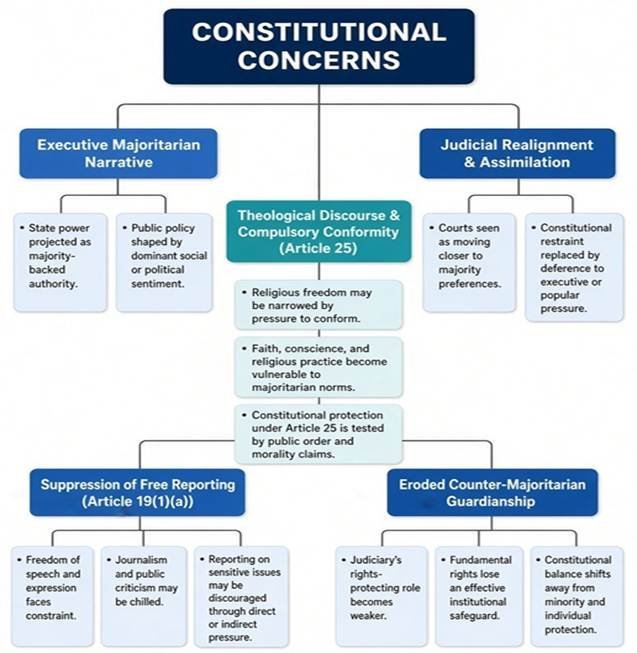
The converging trends of judicial majoritarianism and press restriction reveal a broader structural shift: higher courts increasingly echo state priorities rather than serving as independent arbiters.
The judiciary’s willingness to normalize mandatory state rituals reflects an internal alignment with state-led cultural homogenization, in all probability a hidden precursor of gradual compulsory religious subjugation of members of the Abrahamic religions.
When judges dismiss minority objections to state directives, they endorse the premise that national unity requires mandatory symbolic compliance.
Suppressing Scrutiny to Preserve Majoritarian Consensus :
Controlling press coverage of courtroom dialogue protects these shifting judicial norms from public challenge.
Restricting reporting shields theological reasoning and majoritarian assumptions which ought never to figure in a secular judge’s mind, from critical evaluation, preventing public debate on the drift away from precedents like Bijoe Emmanuel.
Abandonment of Article 30 Guarantees : Forcing minority-run educational institutions to adopt state-mandated religious rituals undermines the structural autonomy guaranteed under Article 30(1). When courts prioritize state assimilation directives over fundamental rights, they alter the constitutional balance between individual liberty and state power.
The strength of constitutional democracy depends on a judiciary that defends pluralism and subjects both executive power and its own proceedings to public scrutiny. Departing from Bijoe Emmanuel v. State of Kerala to demand symbolic conformity, while simultaneously attempting to limit press reporting of judicial exchanges, represents a structural retreat from constitutional principles.
When the judiciary adopts state narratives and seeks insulation from public critique, it undermines its role as the protector of fundamental rights.
National integrity cannot be constructed through compelled speech or restricted reporting; it requires an independent judiciary willing to protect freedom of conscience, preserve press freedom, and defend the right to dissent.
Jai Hind
Disclaimer:The views and opinions expressed in this article are those of the author(s) and do not necessarily reflect the official policy or position of The Rift.