Opening The Rift
therift
© 2026 The Rift. All Rights Reserved.
The Architecture of Coercion : Executive Sclerosis, Pre-emptive Policing, and the Breakdown of Civic Trust
When public administration degenerates into rent-seeking and institutional inertia, governance becomes an extractive gatekeeper, replacing responsiveness with pre-emptive containment.


Representative Image
Key Takeaways
1 of 3
Automatically generated. Read full article for complete context.
Modern democratic theory posits that the sovereign legitimacy of the state rests upon a reciprocal covenant: the preservation of order and the protection of fundamental liberties in exchange for civic allegiance. When public administration degenerates into rent-seeking and institutional inertia, governance ceases to be a facilitator of productive life and becomes an extractive gatekeeper. This institutional sclerosis manifests acutely in public order policing, where the administrative state increasingly replaces democratic responsiveness with pre-emptive containment, interdicting speech, curtailing mobility, and applying prior restraint under the mantle of administrative convenience. By examining the political economy of bureaucratic gatekeeping, the constitutional jurisprudence governing preventive detention and assembly, and practical paradigms of community-led conflict de-escalation, this paper charts the trajectory of contemporary governance from defensive coercion toward a sustainable model of institutional legitimacy.
I. The Political Economy of Extraction: Rent-Seeking and Institutional Drift
In classical political philosophy, the moral justification for state authority is inextricably tied to the protection of individual agency. When authorities establish an environment where civic and economic enterprise can proceed unmolested by arbitrary interference, the social contract holds. When that compact erodes, the administrative apparatus undergoes a qualitative transformation: it ceases to function as an impartial arbiter of justice and solidifies into an institutional bottleneck.
This systemic decay is not merely an operational failure of administrative competence; it represents a structural drift toward advantage extraction. As scholars of political theory assert, state functionaries and regulatory bodies frequently allocate institutional authority not to expand civic goods, but to erect procedural barriers designed to yield bureaucratic and political advantages. Economic actors and private citizens find their creative energy redirected from productive enterprise toward navigating arbitrary compliance mandates, transactional influence, and regulatory gatekeeping.
When authority derives its power from granting discretionary dispensations rather than protecting objective rights, a three-fold inversion occurs:
- The Economy of Influence: Societal capital migrates away from industry, research, and grassroots civic engagement toward lobbying, compliance arbitrage, and the pursuit of official patronage.
- The Instrumentalization of the Rule of Law: Law ceases to operate as an impartial shield against coercive interference and instead functions as a selective instrument of executive privilege, shielding institutional inertia while imposing disproportionate compliance burdens on ordinary citizens.
- The Penalty on Independent Virtue: In an ecosystem where regulatory discretion dictates survival, standard civic diligence and professional independence become institutional liabilities, favouring those skilled in institutional manoeuvring over those engaged in substantive value creation.
When administrative fiat establishes that non-productive gatekeepers hold discretionary veto power over productive members of society, institutional trust inevitably fractures. The resulting administrative culture values optics over structural problem-solving. Bureaucratic tenure is secured through risk aversion, procedural deflection, and performative governance. Deprived of rigorous benchmarks of public service delivery, the machinery of state administration settles into strategic inertia, substituting public relations campaigns for structural reform while treating public scrutiny with defensive suspicion.
II. The Jurisprudence of Prior Restraint and Pre-emptive Policing
The pathology of administrative self-preservation is nowhere more evident than in the evolution of preventive public order enforcement. When a governance model loses its capacity for democratic dialogue, it increasingly treats the exercise of civil liberties not as the lifeblood of a constitutional republic, but as an operational hazard requiring neutralization.
The pre-emptive interdiction of organizers, legal practitioners, and commentators prior to planned assemblies, exemplified by boarding commercial transport or executing early-morning domestic detentions to avert scheduled demonstrations, exposes an acute constitutional tension. Ostensibly executed to prevent public disruption, such executive interventions invert core republican safeguards:
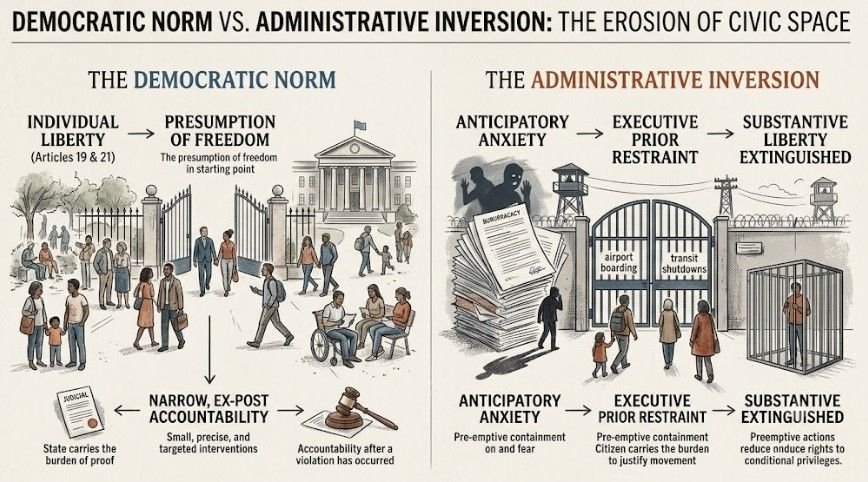
1. The Erosion of Articles 19(1)(a) and 19(1)(b)
The constitutional compact guarantees all citizens the right to freedom of speech and expression under Article 19(1)(a) and the companion right to assemble peaceably and without arms under Article 19(1)(b). As the Supreme Court of India observed in Himmat Lal K. Shah v. Commissioner of Police (1973) and reaffirmed in Anita Thakur v. Govt. of J&K (2016), the right to peaceful assembly serves as an indispensable safety valve within a democratic constitutional order.
The permissible restrictions set forth in Articles 19(2) and 19(3) are strictly conditioned: they must be reasonable, proportionate, and narrowly tailored to preserve public order or state sovereignty. Modern pre-emptive policing, however, frequently relies upon the doctrine of prior restraint. In Babulal Parate v. State of Maharashtra (1961) and Madhu Limaye v. Sub-Divisional Magistrate (1970), the Supreme Court ruled that preventive statutory powers cannot be invoked against speculative anxieties, administrative inconvenience, or mere logistical apprehension. The threshold for coercive intervention demands proximate, clear, and imminent danger to public peace.
Lowering this standard to sanction interception aboard public transit transforms the constitutional test from an objective standard of imminent unlawful conduct into an arbitrary threshold of subjective executive anticipation.
2. The Statutory Limits of Preventive Custody
The statutory powers historically codified under Section 151 of the Code of Criminal Procedure, 1973 (and preserved under Section 172 of the Bharatiya Nagarik Suraksha Sanhita, 2023) grant law enforcement the narrow prerogative to arrest without a warrant only if an officer possesses objective knowledge of an individual’s explicit design to commit a cognizable offence that cannot otherwise be averted.
As the Supreme Court observed in Ahmed Noormohmed Bhatinda v. State of Maharashtra (2015), the exercise of preventive custody is conditioned on this strict factual nexus. Peaceful civic assembly, the presentation of public petitions, or collective demonstrations concerning executive policy do not constitute cognizable offences.
Using preventive custody as a blanket administrative holding device compromises the fundamental protections preserved under Article 21 and Article 22(1). Article 22(1) guarantees that detained individuals must be informed of the grounds of arrest without delay and granted access to legal counsel. When custody is justified merely by vague administrative directives, the statutory requirement for individualized objective satisfaction is replaced by unchecked executive discretion.
3. Proportionality as a Constitutional Anchor
Executive actions that extinguish fundamental freedoms must satisfy the four-pronged test of proportionality affirmed in Modern Dental College & Research Centre v. State of Madhya Pradesh (2016) and K.S. Puttaswamy v. Union of India (2017):
| Proportionality Prong | Constitutional Requirement | Deficit in Blanket Pre-emptive Interdiction |
| Legitimate Goal | Action must pursue an objective sanctioned by law (e.g., public order). | Measures frequently target peaceful dissent rather than verified security hazards. |
| Suitability | The measure must have an empirical, rational nexus to the stated objective. | Indiscriminate interdiction assumes peaceful assembly will inevitably turn violent. |
| Necessity | The state must select the least intrusive measure available among equally effective options. | Extreme measures (transit disruptions, early detentions) are deployed ahead of ordinary crowd management. |
| Balancing | The societal benefit secured must outweigh the severity of the fundamental rights extinguished. | Total extinguishment of Articles 19(1)(a), 19(1)(b), and 21 to avoid routine logistical friction. |
The consistent application of this standard reflects the principles established in Ramlila Maidan Incident v. Home Secretary, Union of India (2012) and Mazdoor Kisan Shakti Sangathan v. Union of India (2018): peaceful demonstration is a democratic reality the state must reasonably accommodate, not an inconvenience it may summarily suppress.
III. The Pathologies of Administrative Overreach
A state apparatus that routinely resorts to maximalist pre-emptive interventions projects an appearance of administrative capability that masks deeper institutional anxieties. A stable constitutional democracy accommodates public mobilization through regulatory facilitation, transparent route management, and proportionate crowd stewardship.
When an administrative apparatus depends on intercepting domestic travellers, sealing residences, shuttering mass transit hubs, and canceling rail services to manage assembly, it reveals deep organizational insecurity. In such scenarios, the administrative state adopts an asymmetric defensive posture against unarmed citizens seeking civic engagement:
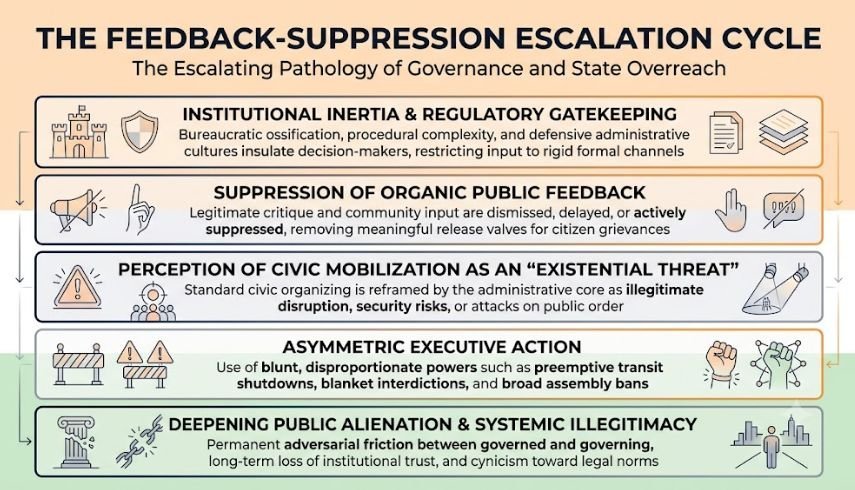
This cycle exacts steep societal costs. Treating the intention to assemble as a latent public hazard insulates political authorities from direct accountability, while depriving the state of critical feedback. When lawful channels of assembly are blocked by pre-emptive enforcement, legitimate grievances are forced outside institutional channels, paradoxically heightening the risk of the civic instability the authorities intended to prevent.
IV. Reconstructing the Public Square: From Coercive Confrontation to Integrated Civic Dialogue
Dismantling this coercive cycle requires structural alternatives that replace reactive, adversarial enforcement with collaborative dispute resolution. Sustainable public order is not generated by interdiction; it is built through steady, mutual civic engagement.
The institutional framework often described as Community-Oriented Policing, embodied by structured dialogues such as the “Coffee with a Cop” model, offers a practical template for lowering tension between administrative bodies and the public. Rather than treating policing as an ex-post punitive response or an anticipatory containment measure, this framework re-anchors authority in community dialogue.
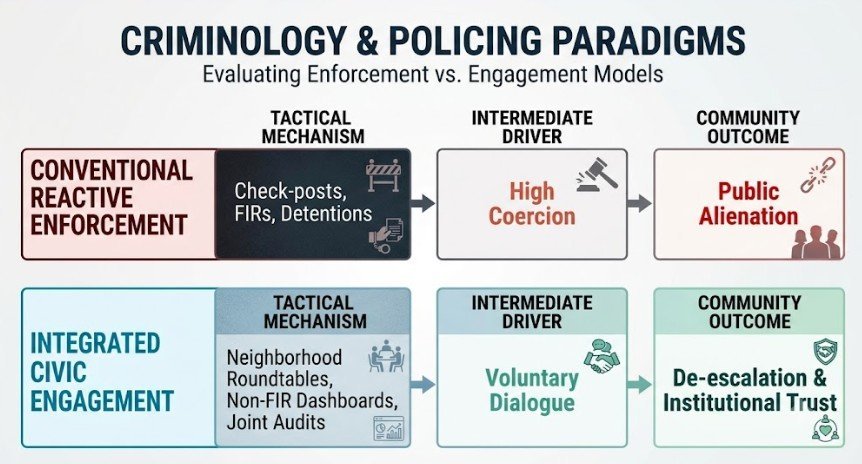
Strategic Components of an Integrated Civic Dialogue Model
- 1. Institutionalizing Bidirectional Intake Platforms:
Community discussions must be supported by transparent, non-FIR digital logging platforms. Specific neighbourhood concerns, unlit public transit hubs, predatory lending schemes, cyber harassment vectors, should be documented with standard turnaround times assigned to local municipal and precinct units, followed by public reporting during subsequent meetings.
- 2. Decentralizing Beyond Elite Corridors:
Civic dialogue programs frequently stall when confined to affluent commercial districts or tech corridors. The model must expand into high-density urban wards, peri-urban transit hubs, and regional educational institutions where alienation from state authority is most acute. Neutral community spaces, neighbourhood tea stalls, local libraries, municipal schools, provide the venue required to discuss systemic frictions before they turn adversarial.
- 3. Empowering the Beat Constable as Lead Mediator:
While senior administrative presence lends formal support to civic initiatives, enduring trust depends on frontline personnel. Station-level officers and beat constables must be trained in conflict mediation, public communication, and cyber literacy, transforming them from enforcers of administrative decrees into trusted neighbourhood arbiters.
- 4. Integrating Behavioural and Community Health Support:
Many public order frictions stem from domestic distress, substance abuse, and unchecked mental health crises. Integrating social work practitioners and community counsellors into neighbourhood outreach platforms ensures that personal and familial crises receive mediation before deteriorating into cognizable criminal complaints.
- 5. Decentralized Cyber and Fraud Literacy Cadres:
As predatory financial applications, impersonation rackets, and phishing schemes proliferate, peer-to-peer educational networks offer a scalable solution. Training student volunteers and community youth as certified safety liaisons distributes defensive literacy directly into peer networks, mitigating crime without invasive surveillance.
Operational Framework : Reactive Enforcement vs. Integrated Dialogue
| Operational Dimension | Conventional Reactive Model | Integrated Civic Dialogue Model |
| Primary Interaction Point | Post-incident FIRs, security checkpoints, police lockups. | Neutral neighbourhood forums, academic auditoriums, open community centres. |
| Information Flow | Adversarial interrogations, emergency calls, unilateral directives. | Voluntary civic exchanges, early problem identification, mutual feedback. |
| Cybercrime Mitigation | Ex-post complaint registration, freezing drained bank accounts. | Proactive digital literacy, peer-led warnings on malicious vectors. |
| Public Sentiment | Administrative wariness, fear of procedural entrapment. | Shared public ownership, mutual problem solving. |
| Resource Allocation | Intensive post-incident investigation, crowded court dockets. | Upfront mitigation, decreased volume of avoidable litigation. |
V. Reclaiming the Constitutional Balance
A polity that measures its stability solely by its capacity to shut down transit networks, pre-empt assemblies, and deploy preventive custody confuses administrative compliance with genuine stability. When administrative convenience displaces the hard work of democratic engagement, the social contract decays from within.
Preventive containment cannot substitute for open governance, nor can administrative intimidation replace democratic legitimacy. The rule of law survives not because the state commands the power to halt an aircraft or silence an organizer, but because its institutions are perceived as just, reasonable, and anchored in fundamental rights.
Reclaiming the constitutional promise of the republic requires reining in the doctrine of administrative prior restraint and recommitting the machinery of state to active, transparent civic dialogue.
Sustainable stability is not achieved when citizens fall silent under the watchful eye of an anxious bureaucracy; it is forged when an accountable, confident state sits across from its people in the light of the public square, willing to listen.
Jai Hind
Disclaimer:The views and opinions expressed in this article are those of the author(s) and do not necessarily reflect the official policy or position of The Rift.