Opening The Rift
therift
© 2026 The Rift. All Rights Reserved.
Can You Reset the Six-Month Clock? The Deepak Prakash Case and the Limits of Article 164(4)
Can a constitutionally limited period for holding ministerial office without being a legislator be effectively restarted through reappointment?

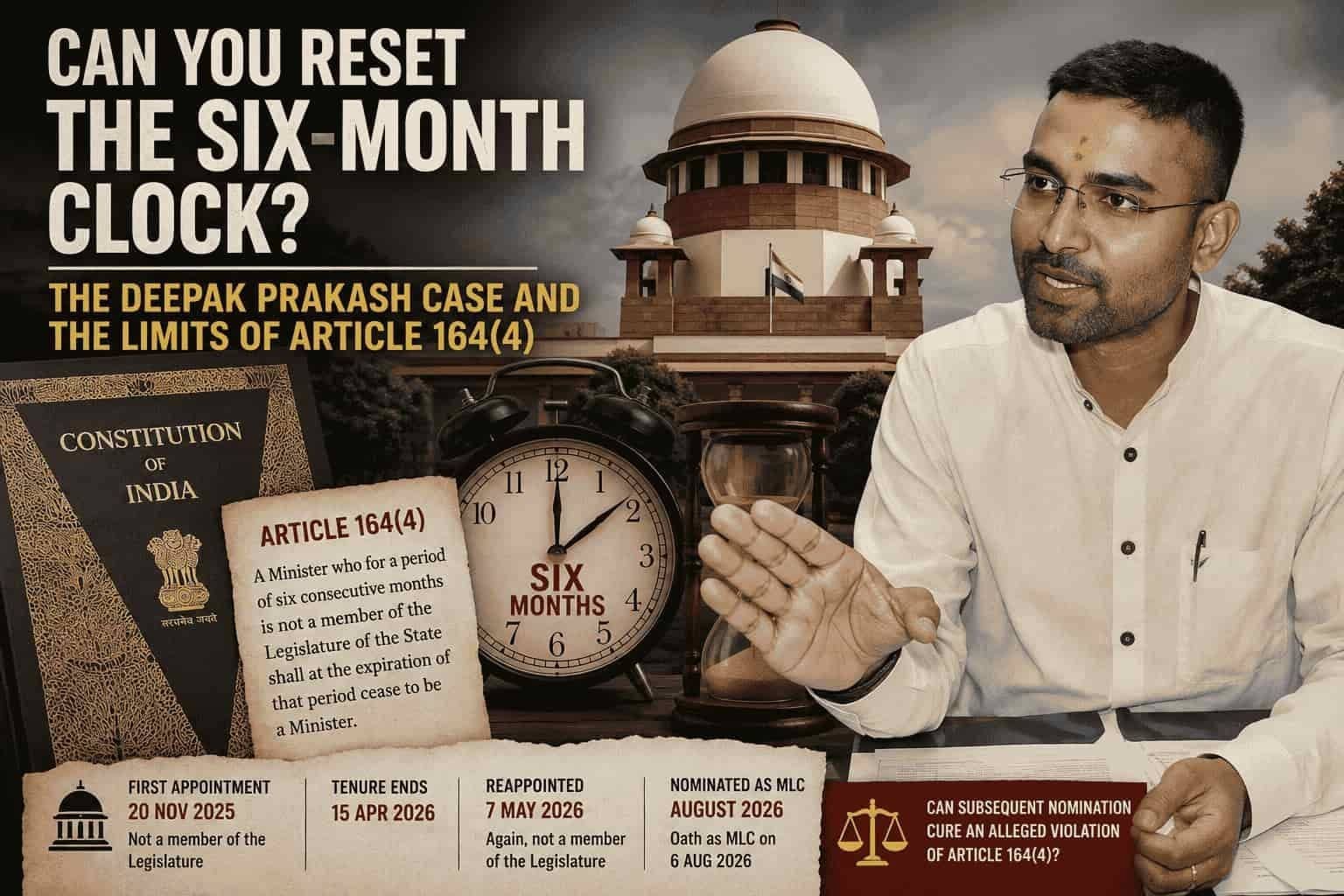
The Deepak Prakash case raises questions about the limits of Article 164(4) (Representative Image)
Key Takeaways
1 of 3
Automatically generated. Read full article for complete context.
Here is the question the Bihar government would rather not answer directly: if a person can hold ministerial office without being a legislatorLegislatorA person who makes laws; a member of a legislature (e.g., Parliament or State Assembly/Council). only for a constitutionally limited period, can that period effectively be restarted through reappointment before he finally enters the legislature? That, stripped of procedural noise, is what the Supreme Court is actually being asked in the Deepak Prakash matter—a far more interesting question than news coverage suggests.
The bare facts are not seriously disputed: Deepak Prakash, who was not a member of either House of the Bihar Legislature, was sworn in as the state’s Panchayati Raj Minister on 20 November 2025, under the then Chief Minister Nitish Kumar. That Council of MinistersCouncil of MinistersThe body of senior ministers, led by the Chief Minister (at the state level) or Prime Minister (at the central level), who advise the Governor/President and exercise executive authority. ended on 15 April 2026 with a change of government, before six months had run. He was reappointed to the same portfolio on 7 May 2026 by the new Chief Minister Samrat Choudhary — again without legislative membership. A writ petition, Rakesh Kumar Singh v. State of Bihar & Ors., W.P. (C) No. 746/2026, was filed seeking a writ of quo warranto, and in the course of the hearings the Chief Justice-led bench pointedly asked the state how an unelected minister could remain in office for this length of time at all. Then, in August 2026, Prakash was nominated to the Bihar Legislative Council and took his oath as an MLC on 6 August. The following day, the Solicitor General argued before the Court that his subsequent nomination and oath as an MLC satisfied the constitutional requirement for continued ministerial office.
That last move is the crux of this piece. Does becoming an MLC in August answer a constitutional question about what happened between November and May?
What Article 164(4) Actually Permits
Article 164(4) is deceptively short: a minister who is not a member of the legislature for six consecutive months ceases, at the end of that period, to be a minister. Read with Article 164(1), which places no eligibility condition on who the Governor may appoint as a minister, the provision is best understood as a controlled exception rather than a general licence. Parliamentary government assumes that the executive answers to an elected legislature; Article 164(4) simply builds in a short grace period for a Chief Minister to bring an outside talent into the Council of Ministers before requiring that person to secure membership of the State Legislature. It is worth being precise here, the Constitution does not insist on direct election. Membership of a Legislative Council obtained through nomination, where constitutionally available, satisfies the requirement just as election to the Assembly would. That is exactly the route Prakash eventually used, which is part of what makes the state’s argument in August viable at all. What Article 164(4) was never meant to do is create a standing category of ministers who function indefinitely, election or nomination perpetually deferred, by virtue of periodic reappointment.
The Har Sharan Verma Line and the Textual Starting Point
The constitutional text has been tested before, mostly by a persistent litigant. In Har Sharan Verma v. Tribhuvan Narain Singh, (1971) 1 SCC 616, a Constitution Bench upheld the appointment of T.N. Singh as U.P. Chief Minister despite his not being a legislator at the time, reading Article 164(4) precisely as it is worded: a person may be appointed and then must secure membership within six months, failing which the office lapses. The same litigant returned in \*Har Sharan Verma v. State of U.P., (1985) 2 SCC 48, arguing that the 1963 amendment to Article 173(a) had implicitly closed this route. The Court disagreed, holding that Article 173(a) governs qualification for legislative membership, not eligibility for ministerial appointment, and that Article 164(4) survived the amendment untouched. Both decisions confirm that the six-month allowance is textually real and cannot be argued away. They establish the foundation on which everything else rests, but neither case involved a second appointment of the same person after an earlier stint had already run its course, which is precisely the gap the Deepak Prakash facts occupy.
S.R. Chaudhuri and the Anti-Circumvention Principle
This is where S.R. Chaudhuri v. State of Punjab, (2001) 7 SCC 126, does the real work, and it is the primary authority for this controversy. The facts are strikingly close to the present ones. Tej Parkash Singh had been appointed a Punjab minister without legislative membership, failed to get elected within six months, and resigned. When the Chief Minister changed within the life of the same Assembly, the new Chief Minister reappointed him, again without his having been elected in the interim. The Supreme Court held that reappointment invalid. Its reasoning went directly to the structure of Article 164: the six-month opportunity is a privilege personal to the individual minister, not something the appointing Chief Minister can hand out afresh merely because government leadership has changed. A change of Chief Minister during the term of the same Assembly, the Court said, is of no consequence to a person who has already exhausted or is exhausting that opportunity. Indeed, S.R. Chaudhuri addressed the precise constitutional temptation presented here: whether resignation before the six-month period expires can be followed by reappointment without legislative membership. The Court rejected that possibility, holding that the six-month opportunity is personal to the minister and cannot be renewed simply because the appointing political executive has changed.
Against that background, S.R. Chaudhuri is particularly significant because it rejects an interpretation of Article 164(4) that would allow the six-month period to function as a mechanically resettable countdown. B.R. Kapur v. State of Tamil Nadu, (2001) 7 SCC 231, is worth noting in the background; it holds that constitutional eligibility conditions for high office cannot be defeated by formal compliance that ignores their underlying purpose, there in the context of a disqualification arising from criminal conviction. It supports the same general instinct against formalism, but it did not decide the Article 164(4) reappointment question and should not be read as though it did. The weight in this case rests on S.R. Chaudhuri, with Har Sharan Verma as the foundational text it builds on.
The May Reappointment and the Question It Actually Raises
It is worth being precise about what is genuinely contested here, because the two sides are not disagreeing about the same thing. The state’s position is that the first Council of Ministers ended within six months, and that the 7 May appointment was a distinct exercise of gubernatorial powerGubernatorial PowerRefers to the powers and authority vested in the Governor of a state, particularly in the context of appointing ministers. under Article 164(1), untainted by anything that came before. The petitioner’s position, drawing directly on S.R. Chaudhuri is that the identity of the appointing Chief Minister is irrelevant; the six-month opportunity belonged to Prakash personally, ran once between November and the following May, and could not be reopened by a new government simply reappointing the same person. On the chronology as reported, six months from the original 20 November 2025 appointment would have expired around 20 May 2026 less than two weeks after the fresh appointment on 7 May. Whether that timing strengthens the petitioner’s argument that this was, in substance, a continuation rather than a genuinely new appointment, is exactly the kind of question the Court will need to examine closely rather than take at face value.
Does the August MLC Nomination Cure the Earlier Problem?
The second and, to my mind, more original question is whether becoming an MLC in August answers either of the above concerns. The constitutional question has two temporal dimensions: whether Prakash is presently entitled to hold ministerial office, and whether the executive act by which he was reappointed on 7 May 2026 was constitutionally valid when made. The former may have changed in August; the latter does not necessarily disappear with it.
There is, however, a procedural complication worth taking seriously. Quo warranto ordinarily examines the present legal authority to hold a public office, which gives real weight to the state’s argument that Prakash’s induction into the Legislative Council changes the relief that can practically be granted going forward. But a subsequent change in status does not necessarily answer whether the earlier appointment complied with the constitutional limitation applicable at the time it was made. Curing a defect prospectively is different from declaring that no defect ever existed, and S.R. Chaudhuri’s insistence that the six-month privilege is personal and non-renewable suggests the Court has already shown some willingness to look past the formal fact of a later appointment to ask whether an earlier one was itself sound.
Constitutional Limits Versus Formal Compliance
My own reading, offered while the matter remains sub judice, is that the Court should resist collapsing these two questions into one. The MLC nomination may substantially affect the forward-looking relief of removing Prakash from office, since he is now a member of the Legislature. But that does not necessarily answer whether his reappointment on 7 May 2026 was constitutionally permissible when it occurred. Whether the Court chooses to answer that narrower question on the facts before it, or treats the petition as substantially overtaken by events now that Prakash sits in the Council, is exactly the kind of judgment call that makes this case worth watching rather than assuming resolved.
Disclaimer:The views and opinions expressed in this article are those of the author(s) and do not necessarily reflect the official policy or position of The Rift.