Opening The Rift
therift
© 2026 The Rift. All Rights Reserved.
The Watchdog Under Watch: Can India’s Election Commission Remain Institutionally Independent?
Independence must be assessed alongside the safeguards governing appointments, decision-making, electoral-roll administration and accountability.


Key Takeaways
1 of 3
Automatically generated. Read full article for complete context.
The watchdog and the crisis of trust
A referee’s authority does not come from the whistle alone. It comes from the shared belief that the whistle is blown by someone answerable to the rules, rather than to a team. The Election Commission of India (ECI) occupies a comparable position in India’s constitutional democracy. It administers the contest through which representative government is formed, and its credibility is part of the infrastructure on which electoral legitimacy depends.
That credibility has come under renewed scrutiny. In September 2026, The Indian Express reported that Election Commissioners Sukhbir Singh Sandhu and Vivek Joshi had recorded written objections on multiple occasions concerning decisions and administrative steps associated with the Special Intensive Revision (SIR) of electoral rolls. The reported concerns included the handling of electoral-roll data, changes associated with Form 6 and the allocation of administrative work. The ECI acknowledged that internal notes and observations existed, but characterised them as part of ordinary deliberation and maintained that its decisions had been unanimous.\[1\]
APPOINTMENT COMMITTEE COMPARISON
Election Commissioner Appointment Process: Pre- and Post-2023 Act
Supreme Court (Interim)
Anoop Baranwal Directive (2023)
- Prime Minister
- Leader of Opposition (Lok Sabha)
- Chief Justice of India
Parliamentary Act (2023)
CEC & Other ECs Act, 2023
- Prime Minister
- Union Cabinet Minister (PM Nominee)
- Leader of Opposition (Lok Sabha)
VISUALS BY THE RIFT
These competing accounts must be kept distinct. The existence of internal objections does not, by itself, establish that a decision was unlawful. Equally, an institutional statement of unanimity, without the relevant record, does not answer every question about the process by which a decision was made. As of 10 October 2026, the reported proceedings had not produced a final judicial finding that the allegations established institutional misconduct. The controversy is therefore best treated as a test of institutional design, not as a verdict already reached.
The central question is whether India’s constitutional framework protects the ECI’s independence both in the selection of its members and in the exercise of its collective authority. The argument advanced here is that constitutional status alone is insufficient. Independence must be assessed alongside the safeguards governing appointments, decision-making, electoral-roll administration and accountability. The SIR controversy makes those safeguards unusually visible.
The constitutional promise of Article 324
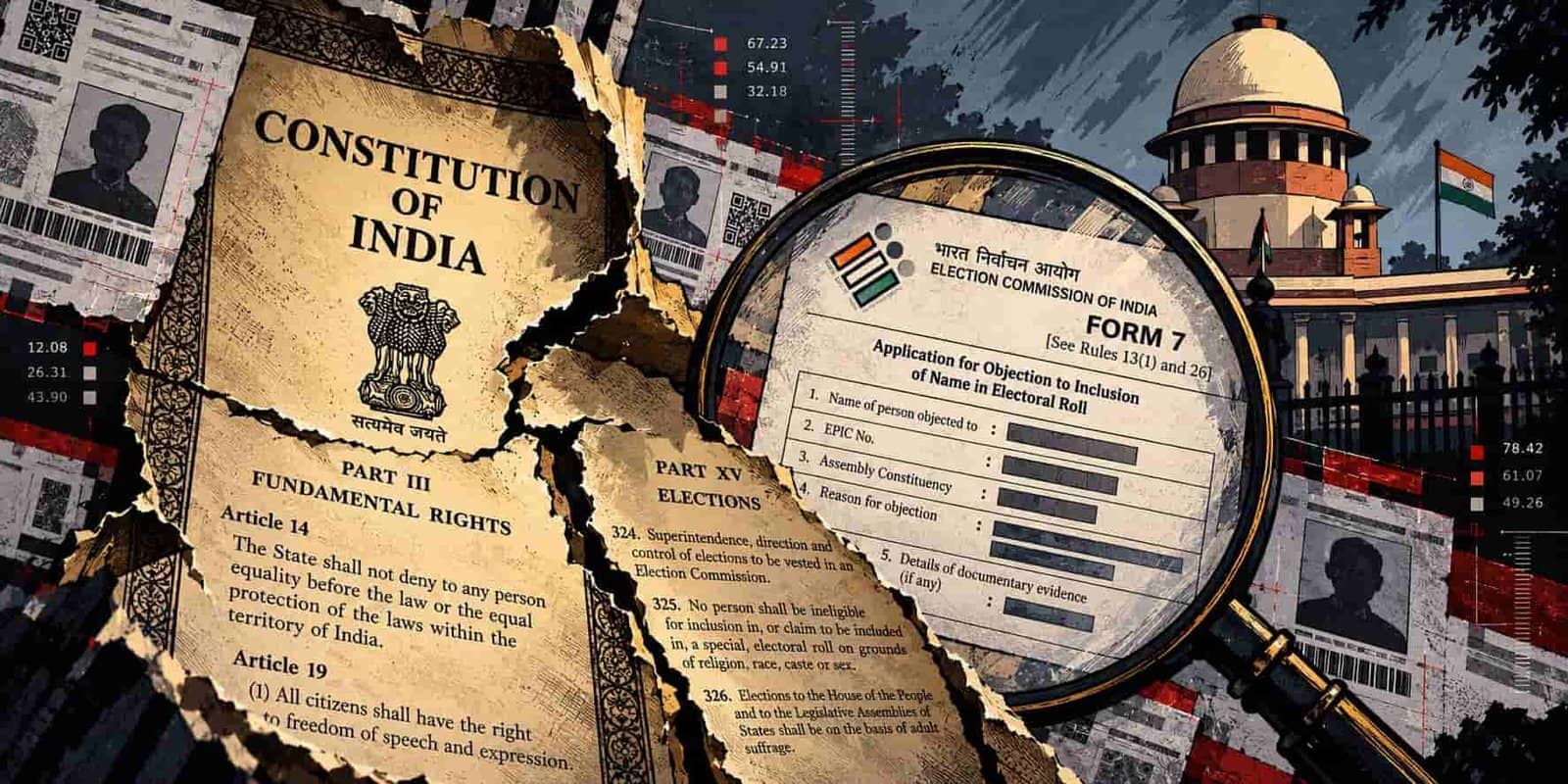
Article 324 vests the “superintendence, direction and control” of elections in the ECI. The provision gives the Commission a central constitutional role, but it does not place the institution outside the legal order. Its authority must be read alongside Parliament’s power to legislate on elections, the statutory framework for electoral registration and the rights of eligible voters.
In Mohinder Singh Gill v. Chief Election Commissioner, the Supreme Court treated Article 324 as a broad source of authority capable of filling gaps where election law is silent. That breadth enables the Commission to respond to practical circumstances that legislation may not exhaustively anticipate. It is not, however, a licence to disregard binding law. In A.C. Jose v. Sivan Pillai, the Court held that the Commission could not use Article 324 to override legislation or rules that governed the matter.
The distinction is crucial to the present debate. The question is not simply whether the ECI has power to revise electoral rolls. It is whether a particular measure falls within its constitutional authority, is consistent with applicable legislation and rules, and is accompanied by safeguards proportionate to its effect on electors. A broad constitutional mandate and compliance with statutory procedure are not competing ideals. They are meant to operate together.
Articles 325 and 326 add a related, but distinct, dimension. Article 325 prohibits exclusion from electoral rolls on specified grounds, while Article 326 establishes adult suffrage subject to constitutional and statutory qualifications. These provisions protect the electoral participation of citizens. They do not directly answer whether the Commission is institutionally independent. Keeping the questions separate avoids a common analytical mistake: an independent institution may still administer a process that requires legal correction, while procedural accountability can strengthen rather than diminish its independence.
From Anoop Baranwal to the 2023 appointment law
The appointment of Election Commissioners has long been central to the debate about independence. In Anoop Baranwal v. Union of India, decided on 2 March 2023, a Constitution Bench considered the absence of a parliamentary law specifically regulating the appointment process. As an interim arrangement pending legislation, the Court directed that appointments be made on the recommendation of a committee comprising the Prime Minister, the Leader of the Opposition in the Lok Sabha, or the leader of the largest opposition party where applicable, and the Chief Justice of India.\[3\]
The significance of the judgment lies in its institutional reasoning. The concern was not a finding that every executive appointment would necessarily produce partisan conduct. It was that an appointment arrangement concentrated in the executive could create a structural risk of dependence for an institution required to administer elections involving the government of the day.
Parliament subsequently enacted the Chief Election Commissioner and Other Election Commissioners (Appointment, Conditions of Service and Term of Office) Act, 2023. The Act’s Selection Committee includes the Prime Minister, a Union Cabinet Minister nominated by the Prime Minister, and the Leader of the Opposition in the Lok Sabha. In practical terms, the executive representatives can outvote the opposition representative. Critics argue that this design offers insufficient protection against executive dominance. Defenders point out that the Constitution contemplated legislation by Parliament and that the arrangement in Anoop Baranwal was expressly interim.\[4\]
Both propositions deserve attention. The fact that Parliament legislated does not end the constitutional debate about whether the resulting design adequately protects independence. Conversely, departure from the Court’s interim arrangement does not, by itself, establish that the statute is unconstitutional. Three questions should be kept separate: whether the Act is constitutionally valid, whether its structure offers sufficient institutional safeguards, and whether there is evidence that the appointment system has affected a particular decision. The first is a question for constitutional adjudication. The second is a legitimate subject of institutional reform. The third requires evidence rather than inference.
The appointment framework therefore raises a serious question of public confidence, but it should not be treated as proof of bias in the conduct of the Commission. The more defensible conclusion is narrower: where an institution’s legitimacy depends on impartial administration, the design of its appointment process should minimise both actual dependence and reasonable doubts about dependence.
The SIR controversy: authority, procedure and the voter
The SIR of electoral rolls brought these questions into sharper focus. The exercise was challenged on grounds that included the ECI’s authority to conduct it, the documentation required, the risk of wrongful exclusion and compliance with the Representation of the People Act, 1950Representation of the People Act, 1950An Act of the Indian Parliament that deals with the preparation of electoral rolls and the delimitation of constituencies for elections to Parliament and state legislatures. and the Registration of Electors Rules, 1960Registration of Electors Rules, 1960Rules framed under the Representation of the People Act, 1950, that govern the procedure for registration of electors, including the forms and declarations required..
In Association for Democratic Reforms v. Election Commission of IndiaAssociation for Democratic Reforms v. Election Commission of IndiaA legal challenge brought before the Supreme Court of India, often concerning electoral processes, transparency, and the functioning of the Election Commission. The article refers to a specific case related to the SIR process., decided on 27 May 2026, the Supreme Court considered the legality and proportionality of the Bihar SIR and the Commission’s authority under Article 324. The judgment recognised the constitutional importance of accurate electoral rolls and upheld the Commission’s authority to conduct the exercise, while also addressing procedural safeguards and the legal treatment of persons affected by deletion.\[5\] It should not be read as blanket approval of every later administrative step, form modification or internal decision associated with subsequent phases of the SIR.
That distinction matters in relation to the reported dispute over Form 6, which is used by applicants seeking inclusion in the electoral roll. Reporting in September described objections to an additional declaration associated with the SIR, including whether a requirement affecting applicants could be introduced without amending the Registration of Electors Rules, 1960. The ECI subsequently stated that the SIR declaration would apply in the relevant SIR context while the prescribed form under the Rules would be used outside it. Other reporting said the declaration was withdrawn from the online Form 6 in certain circumstances following a full-Commission meeting.\[6\]
On 5 October, the Chief Justice of India was reported as clarifying that the Supreme Court had not approved a modified version of Form 6. The Court’s reported approach was to examine the relevant record rather than presume, on the basis of newspaper reports alone, that decisions had been taken unilaterally.\[7\] That is an important distinction. Judicial scrutiny of the decision-making process is not equivalent to a finding that the Commission acted unlawfully.
The controversy also concerns the allocation of authority inside a multi-member body. Section 18 of the 2023 Act provides that the Commission may, by unanimous decision, regulate the procedure for transacting its business and allocating business among its members. It further provides that business should, as far as possible, be transacted unanimously, and that differences of opinion are to be resolved by majority.\[8\] The provision makes collective decision-making a legal question, not merely an internal management preference.
The practical inquiry is therefore specific. Was a disputed step a decision reserved to the Commission, or an administrative implementation of an earlier decision? If it was a Commission decision, what record demonstrates compliance with Section 18? Did members have the opportunity to deliberate, and was any disagreement resolved through the statutory process? A written objection may indicate careful scrutiny. It may also point to a procedural problem. Its significance depends on the sequence of events and the underlying documents.
The ECI’s position, that differences expressed during deliberation do not necessarily negate a unanimous final decision, is plausible. collegial institutions should be able to debate proposals without every disagreement becoming a public crisis. But where objections allege that decisions were implemented without the knowledge of other members, the public interest is not served by relying only on general assurances. The appropriate response is to establish, from the official record, which decision was made, by whom, under what authority and through what process.
A further development illustrates why procedural safeguards must be considered from the voter’s perspective. On 9 October 2026, the ECI introduced limits on the number of Form 7Form 7The prescribed form used to object to the inclusion of a name in the electoral roll or to request the deletion of a name, often due to death, duplication, or ineligibility. objections an individual may submit seeking deletion of names from electoral rolls. According to contemporary reporting, the limits were up to ten during the claims-and-objections period and five per month during routine updating. The stated context was concern about bulk submissions and avoidable inconvenience. The effectiveness and legality of such safeguards should be assessed by reference to the governing Rules, the need to prevent misuse, and the ability of legitimate objections to be considered fairly.\[9\]
The underlying principle is not that every deletion is wrongful, or that every revision is suspect. Electoral rolls must be accurate. Duplicate, deceased or otherwise ineligible entries should be addressed according to law. But the scale of a revision cannot substitute for individual procedural fairness. The relevant questions are whether eligible electors receive appropriate notice, whether decisions are based on lawful criteria, and whether affected persons have accessible and timely avenues to challenge errors.
Independence with accountability: a reform agenda
The present controversy should not be used to presume wrongdoing, but it does expose areas in which institutional practice could be made more transparent. The following proposals are intended to improve verifiability while preserving the confidentiality necessary for candid internal deliberation.
First, the ECI should publish concise records of formal Commission decisions, identifying the legal authority relied upon, the date of decision and whether the outcome was unanimous or reached by majority. This need not require publication of every internal note or preliminary exchange. The objective is to make the final decision and its lawful basis auditable.
Second, recorded dissent should be treated as a normal feature of collegial decision-making. A short dissenting note, where a member chooses to publish one and disclosure is legally appropriate, can clarify the issue in dispute without converting disagreement into an allegation of institutional failure. Transparency should not require the release of every working paper. It should permit the public to understand how consequential decisions were authorised.
Third, the Commission should clarify which categories of decisions must be taken by the full Commission and which may be delegated to officials. The boundary is particularly important where administrative measures affect voter registration, access to electoral-roll data or the prescribed forms used by electors. Clear rules on delegation would reduce uncertainty and help distinguish routine implementation from decisions requiring collective approval.
Fourth, changes affecting the conditions or documentation for voter registration should be made through the legally prescribed route. Where legislation or rules govern a form or requirement, the Commission should identify the source of authority for any variation and explain whether formal amendment is required. This approach protects both legal certainty and the Commission itself. Decisions taken through the correct process are more defensible when challenged.
Fifth, the appointment framework should remain open to review. A selection process that includes meaningful participation beyond the incumbent executive may provide stronger assurance of independence. Any reform, however, should be assessed against constitutional text, institutional feasibility and comparative practice rather than the assumption that one committee design guarantees impartiality.
Finally, transparency must be matched by effective remedies for voters. Clear notices, accessible correction procedures, reasoned decisions where appropriate, and timely review are especially important during large-scale revisions. Institutional accountability is not only about how Commissioners relate to one another. It is also about whether citizens can understand and challenge decisions that affect their participation in elections.
Conclusion: independence must be demonstrable
The ECI’s independence has at least two dimensions. structural independence concerns the process through which Commissioners are selected and the safeguards against dependence. operational independence concerns how the Commission exercises its authority once constituted, including whether decisions are taken collectively and within the law. The 2023 appointment framework raises continuing questions about the first dimension. The reported SIR dispute has made the second dimension a matter of immediate public concern.
The Commission maintains that its decisions were unanimous and that internal differences were part of ordinary deliberation. Commissioners reportedly raised objections, and the courts have been asked to examine aspects of the process. Until the relevant records are assessed and the legal proceedings resolve the disputed issues, commentary should resist declaring a winner. It should instead insist on the standards that apply regardless of the outcome: statutory compliance, fair procedures, transparent reasons and effective remedies.
A constitutional watchdog does not preserve its independence by being insulated from every question. Nor does accountability require political control over its decisions. Properly understood, accountability for legality is one of the conditions of independence. An institution that can demonstrate that it acted through lawful authority and collective procedure is strengthened by scrutiny. One that cannot explain how consequential decisions were made risks losing the public confidence on which its constitutional role ultimately depends.
Disclaimer:The views and opinions expressed in this article are those of the author(s) and do not necessarily reflect the official policy or position of The Rift.