Opening The Rift
therift
© 2026 The Rift. All Rights Reserved.
Who Gets to define Truth? Youth, Instagram, and the New Politics of Knowledge
In an age where visibility masquerades as credibility and popularity as truth, questioning and deconstructing digital knowledge is essential for sociological consciousness.

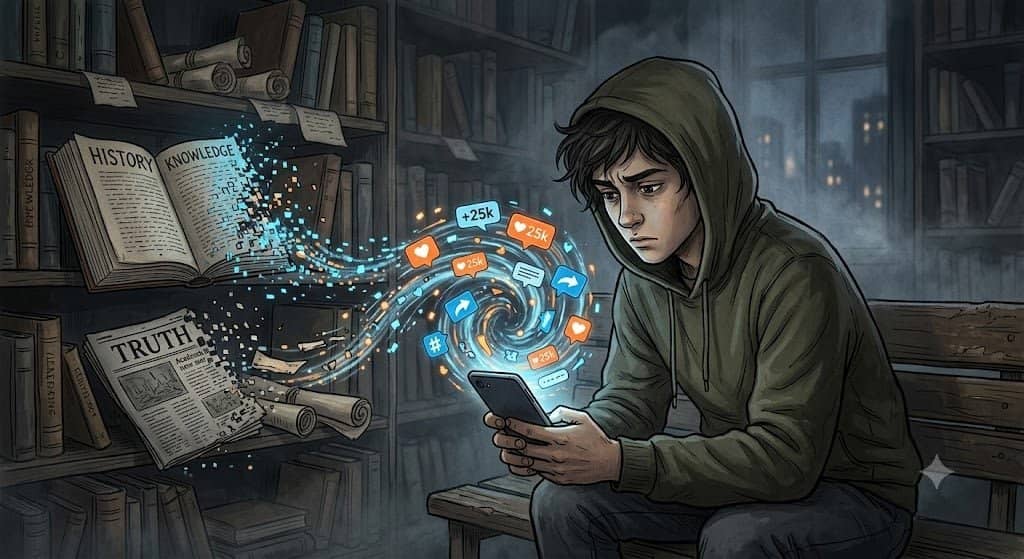
Youth navigating the complexities of truth on social media (Representative Image)
Key Takeaways
1 of 3
Automatically generated. Read full article for complete context.
Instagram is no longer merely a platform for sharing photographs, entertainment and personal updates. For contemporary youth, it has increasingly become a space for encountering information, forming opinions, discovering lifestyles and making sense of social reality. From political events and social movements to health advice, education, relationships and popular culture, an enormous amount of information now reaches young people through Instagram reels, stories, influencers and short-form videos. This transformation raises an important sociological question: what happens when a social media platform becomes an important source through which young people decide what is credible, relevant and true?
The question is not simply about how much time young people spend on Instagram. More significantly, it concerns the changing sources of epistemic authorityEpistemic AuthorityThe legitimate right or power to define, produce, and disseminate knowledge, traditionally held by institutions like universities or experts.—that is, the individuals, institutions and platforms that people regard as legitimate producers of knowledge. Traditionally, institutions such as schools, universities, newspapers, books and experts occupied an important position in determining what counted as legitimate knowledge. Instagram has complicated this arrangement by allowing almost anyone with an account to produce, circulate and influence knowledge.
From Information to Authority
Instagram has transformed the relationship between information and authority. A person does not necessarily need academic qualifications, institutional recognition or professional expertise to acquire a large audience. A creator with millions of followers can become an influential source of information simply through visibility and engagement.
This creates an important sociological paradox: visibility can increasingly be mistaken for credibility.
The number of followers, likes, shares and views attached to a post may create an impression that the information presented must be reliable. A reel viewed millions of times can appear more convincing than a carefully researched article that receives little public attention. Popularity thus becomes a form of symbolic authority.
Pierre Bourdieu’s concept of symbolic capitalSymbolic Capital (Pierre Bourdieu)Non-economic resources (like prestige, recognition, or social honor) that can be converted into other forms of capital and confer power or status within a social field. provides a useful way of understanding this phenomenon. Social recognition itself can become a resource. On Instagram, followers, likes, verification, comments and shares can function as indicators of social legitimacy. The more visible an individual becomes, the greater their perceived authority may become—even when their expertise on a particular subject is questionable.
Therefore, the question is not merely whether young people are consuming information online. It is also how digital forms of recognition influence their judgment of what deserves to be believed.
The Influencer as a New Knowledge Broker
The emergence of the influencer has further transformed this relationship. Influencers occupy an unusual position between celebrity, peer and expert. Unlike traditional experts, they often communicate through informal language, personal experiences and emotionally engaging narratives. Their apparent accessibility creates a sense of intimacy between creator and audience.
This intimacy is sociologically significant.
Young people may feel that they “know” an influencer because they regularly watch their stories, routines, opinions and personal experiences. Consequently, trust may develop not because the influencer possesses formal expertise but because they appear authentic, relatable and familiar.
The distinction between expertise and familiarity therefore becomes blurred.
An influencer discussing politics, mental health, education, beauty, relationships or social problems may receive greater attention than a qualified professional simply because the influencer communicates in a more accessible and emotionally appealing manner. The authority of knowledge consequently becomes intertwined with the politics of presentation.
Erving Goffman’s understanding of the Presentation of selfPresentation of Self (Erving Goffman)A sociological concept describing how individuals attempt to control the impressions others form of them, often by performing specific roles in social interactions. is particularly relevant here. Instagram is a highly curated social environment in which individuals construct particular versions of themselves for an audience. What appears to be spontaneous authenticity may itself be carefully produced. Yet audiences may interpret this carefully constructed presentation as evidence of honesty and trustworthiness.
The Algorithm and the Production of Visibility
Another important dimension is the role of the algorithm.
Young people do not encounter Instagram content randomly. What becomes visible is shaped by algorithmic systems that respond to previous interactions, searches, viewing patterns and engagement. Content that attracts attention is more likely to circulate further, while other forms of knowledge may remain relatively invisible.
This means that Instagram does not simply provide a neutral space in which knowledge exists. It participates in determining which knowledge becomes visible.
Michel Foucault’s relationship between knowledge and power becomes relevant here. Knowledge is never completely detached from the social structures through which it is produced, organized and circulated. In the digital environment, visibility itself becomes a form of power.
If particular ideas are repeatedly presented on a user’s feed, they may gradually begin to appear normal, obvious or universally accepted. Repetition can create familiarity, and familiarity can produce perceived truth.
The danger, therefore, is not only misinformation. It is the creation of epistemic bubblesEpistemic BubblesSocial environments where individuals are primarily exposed to information and perspectives that confirm their existing beliefs, leading to a narrow and reinforced understanding of reality. in which users repeatedly encounter information that confirms what they already believe.
Youth as Consumers and Producers of Knowledge
However, young people should not be understood simply as passive consumers of Instagram content. They are simultaneously consumers, interpreters and producers of knowledge.
A young person may watch a political reel, compare it with another source, discuss it with friends, comment on it, remix it and eventually create their own content. In this sense, Instagram has democratized certain aspects of knowledge production. Individuals who were historically excluded from mainstream media can now narrate their experiences and challenge dominant representations.
This is particularly significant for marginalized communities. Social media can provide spaces where communities articulate experiences that may have been ignored by mainstream institutions. Personal narratives can challenge dominant representations and create alternative forms of knowledge from below.
Yet democratization does not automatically produce epistemic equality. Everyone may have the ability to speak, but not everyone receives equal visibility. Algorithms, popularity, social networks and existing inequalities continue to influence whose voices become amplified.
Thus, Instagram simultaneously opens the possibility of epistemic democratization and reproduces new forms of epistemic inequality.
The New Politics of Truth
The central issue, therefore, is not whether Instagram is “good” or “bad” for young people. Such a binary approach overlooks the complexity of digital social life.
The more important question is: who gets to define what counts as credible knowledge in the digital age?
Instagram has disrupted traditional boundaries between expert and non-expert, producer and consumer, private experience and public knowledge. A personal experience can become a viral claim; a viral claim can become a perceived fact; and a perceived fact can influence collective attitudes and behaviour.
This transformation requires young people to develop not merely digital literacy but epistemic literacyEpistemic LiteracyThe ability to critically evaluate the sources, production, and circulation of knowledge, understanding how information is constructed and whose interests it may serve.—the ability to ask where information comes from, who produced it, what evidence supports it, why it has become visible, and whose interests or perspectives may be absent.
In this context, critical engagement with Instagram should not mean rejecting social media altogether. Rather, it requires developing the ability to deconstruct the authority that digital platforms produce.
Instagram has become more than a communication platform. It is increasingly an important social space in which identities are constructed, relationships are negotiated and knowledge is produced and circulated. For youth, the platform’s significance lies not merely in its popularity but in its capacity to influence what they see, whom they trust and how they interpret social reality.
The growing reliance on Instagram therefore represents a transformation in the sociology of knowledge. Authority is no longer located exclusively in established institutions. It is increasingly negotiated through followers, visibility, engagement, algorithms, influencers and perceived authenticity.
The challenge for contemporary youth is consequently not simply to ask, “Is this information available?” but to ask, “Why should I believe it?”
In an age where visibility can masquerade as credibility and popularity can appear as truth, the ability to question, verify and deconstruct digital knowledge has become an essential form of sociological consciousness.
Disclaimer:The views and opinions expressed in this article are those of the author(s) and do not necessarily reflect the official policy or position of The Rift.