Opening The Rift
therift
© 2026 The Rift. All Rights Reserved.
CJP Sets a New Paradigm in Indian Polity
A new generation is entering the arena with different expectations of authority, accountability and participation, refusing to be controlled.

Key Takeaways
1 of 3
Automatically generated. Read full article for complete context.
Indian politics has become accustomed to talking about the youth as a demographic. The Grand Old Parties Have the Roots and Substance; the Question Is Whether They Can Make Room for Youth Dynamism.
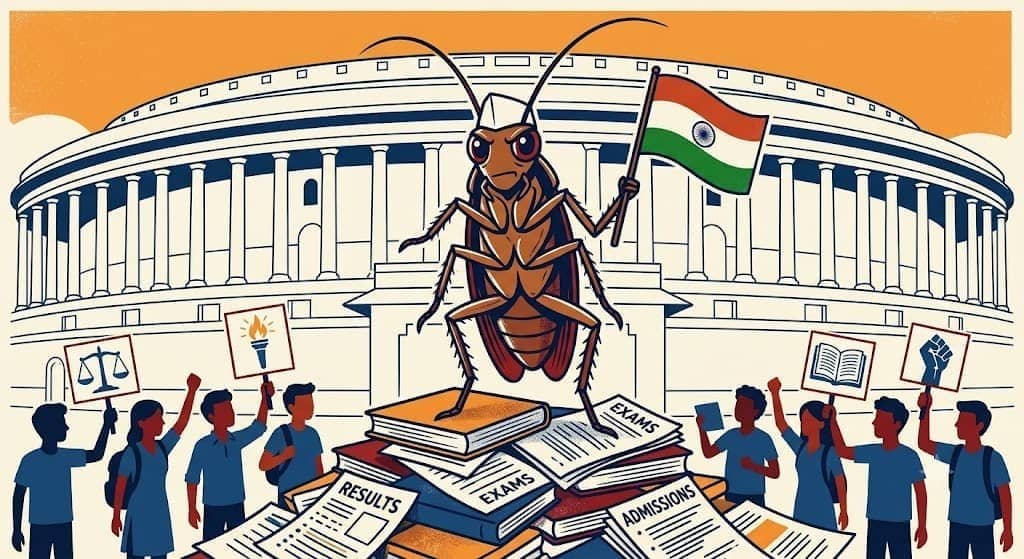
Young India is counted, surveyed, promised jobs, shown technological dreams, brought onto stages during election campaigns and then usually sent back to the margins of political life. The emergence of the Cockroach Janta Party, CJP, has disrupted that comfortable arrangement. It has shown that young people can cease being an electoral category and become a political force.
That is the real significance of CJP.
It would be a profound mistake to reduce the movement to a prospective youth wing of an opposition alliance. A youth wing is subordinate by definition. It belongs to a party, works within its structure and eventually learns the habits of its political parent. CJP presents something potentially quite different. Whatever its formal use of the word “party” and however its organisation develops, its larger significance is as a non-party political formation in relation to the established political order: independent, irreverent, impatient with hierarchy and capable of creating political pressure without waiting for a recognised political organisation to authorise it.
That is what makes the moment interesting. CJP is not the youth wing of tomorrow’s political alliance; it could become its conscience, its monitor and its mobilising force. It could stand beside political parties without becoming their appendage. It could question them, expose them, work with them on particular causes and walk away from them when they fail. Its value would lie precisely in retaining the freedom to say what a party machine often cannot say about itself.
There is something almost instinctive about this development. The name itself began as satire, born out of a remark from the Chief Justice of India that provoked outrage among young people. What could have remained an internet joke became a rapidly expanding youth movement. By July 2026, the protests had moved from the digital world into sustained street mobilisation around examinations, unemployment and accountability. The education minister eventually resigned after weeks of demonstrations and negotiations. International observers noted how rapidly an online satirical formation had acquired a capacity to generate political pressure.
This is where history becomes relevant.
India has seen this kind of political awakening before. Those of us who remember the 1960s and 1970s remember that student politics could escape the campus and enter the bloodstream of the country. The Gujarat Nav Nirman movement began with students and grew into a wider agitation against corruption and economic distress. In Bihar, students confronting unemployment, rising prices, food shortages and corruption turned to Jayaprakash Narayan. JP accepted their invitation on conditions that were extraordinarily important: the movement was to remain nonviolent, and it was not to be controlled by a political party. The student movement acquired a wider social and political character and eventually became one of the forces shaping the crisis of democratic order in the mid-1970s.
The point is not to draw a lazy parallel between 1974 and 2026. The circumstances are entirely different. But there is a common thread. In both moments, young people began with concrete grievances and discovered that the grievance was attached to something larger. The issue was not merely the price of a meal in a hostel, an examination paper or a corrupt official. It was a question of what kind of political system they were being asked to accept.
That is the threshold CJP has now approached.
The first wave of its mobilisation centred on the education system. That itself is revealing. Education has traditionally been described as a sector, a ministry, a budget head. For young Indians it is not an abstraction. It is the road on which families invest years of savings and expectation. It is the examination on which a future is supposed to depend. It is the degree that is meant to open a door. When examination systems are compromised, vacancies remain uncertain and years of preparation can appear to lead nowhere, the anger is not simply about an administrative lapse. It is anger about a broken social promise.
India’s employment record makes that anger intelligible without requiring anyone to exaggerate it. The ILO’s India Employment Report has pointed to a serious problem of educated young people failing to find enough remunerative and productive non-farm employment. It also found that part of the apparent recovery in employment after the pandemic involved unpaid household work, informal low-paying work and other forms of precarious employment. More recent district-level data continue to show substantial regional variation and significant numbers of young people outside employment, education or training.
This is where the fashionable language of economic triumph begins to sound inadequate. A government can cite GDP growth; opposition parties can dispute the quality of that growth. But a young graduate standing in a queue for an examination or a job does not experience the economy as a percentage. He or she experiences it as a possibility or the absence of one. The meaningful economic question is not whether India can produce an impressive headline number. It is whether that expansion is generating secure, productive livelihoods and whether opportunity is reaching beyond those already positioned to benefit from it.
The Modi years therefore deserve to be examined not through government publicity but through outcomes and consequences.
Demonetisation was announced as a dramatic attack on black money, counterfeit currency and illicit wealth. Yet almost all of the demonetised currency ultimately returned to the banking system, while the disruption to a heavily cash-dependent economy was severe. The RBI’s own annual reports document the extraordinary scale of the currency replacement operation and its continuing effects. GST was presented as a historic simplification of India’s tax system. It has created a common indirect-tax framework, but its implementation has also imposed substantial compliance demands, particularly on smaller businesses. COVID-19 exposed another dimension of governance. During the second wave, demand for medical oxygen in some states greatly exceeded available supply; WHO documentation records, for example, oxygen demand in Rajasthan rising far beyond the state’s existing supply during the crisis.
Education tells an equally complicated story. The number of government schools fell from 11.07 lakh in 2014-15 to 10.13 lakh in 2024-25, according to UDISE data reproduced by NITI Aayog. The government explanation includes demographic change and school consolidation, and those factors clearly matter. But the contraction of the public-school network alongside the expansion of private schooling is nevertheless a legitimate subject for political scrutiny.
None of this requires turning every government decision into a scandal or every official statistic into a lie. It requires something more fundamental: refusing to allow political communication to replace political accountability.
And here CJP becomes more interesting.
Its intervention has already moved beyond education. It is now challenging the Election Commission over the Special Intensive Revision of electoral rolls and demanding accountability from Chief Election Commissioner Gyanesh Kumar. The allegations surrounding voter-list deletions are disputed. The Election Commission says the process is lawful and rejects claims of political manipulation; opposition parties and CJP have raised concerns about exclusions, transparency and the integrity of the process. Reuters reported on 28 September that the verification exercise had left roughly 130 million names out of initial draft lists, while also reporting the Election Commission’s defence of the process.
Whether every allegation survives scrutiny is not the point here. The political significance lies elsewhere. A youth movement that began with examinations is now asking who gets to vote, who gets counted and who guards the machinery through which democracy expresses itself. That is a much larger question.
It also explains why CJP should not be hurried into the familiar architecture of Indian party politics.
India’s established parties have something that a new movement cannot manufacture overnight: roots. They have history, cadres, constituencies, ideological traditions, institutional memory and generations of political experience. That matters. Political movements without roots can burn brightly and disappear just as quickly. But roots can also become dead wood. An organisation that remembers only what it was and not what the country is becoming eventually becomes disconnected from the very people it claims to represent.
The new generation is not asking merely to inherit old politics. It is asking whether old politics deserves to be inherited.
That is the challenge.
The established parties, including those seeking to oppose the BJP, cannot simply look at CJP and see a reservoir of young votes waiting to be harvested. That would be precisely the mistake that conventional politics makes whenever something new appears. It treats political energy as an electoral resource rather than as a challenge to the political system itself.
CJP’s usefulness, therefore, may depend on its refusal to become somebody’s junior partner.
Imagine instead a formation that remains outside the formal party structure and watches what governments do after elections. Imagine it tracking promises against performance, questioning budgets, following public procurement, challenging examination failures, investigating institutional lapses, monitoring electoral processes and putting political parties themselves under the same scrutiny it puts governments under. Imagine that, when an issue demands mass action, it can mobilise young people and citizens without first asking a party headquarters whether mobilisation is politically convenient.
That would be a different kind of political power.
It would also be a democratic corrective to the increasingly personalised nature of Indian politics. The politics of personality encourages citizens to ask who the leader is. A monitoring political formation asks a different question: what has the leader done, what has the institution done and what happened to the promise?
That is why the language of “neutralising” one political party is ultimately too small for what CJP represents. The BJP is the dominant political force in contemporary India, and its organisational reach and electoral record cannot simply be wished away. The opposition cannot be rebuilt merely by assembling parties that dislike the BJP. Nor can the future be secured simply by repeating the political grammar of the past. A new generation is entering the arena with different expectations of authority, accountability and participation.
The BJP will inevitably confront that generation. So will Congress. So will every regional party, every established ideological organisation and every political formation that imagines that yesterday’s methods can automatically command tomorrow’s allegiance.
CJP has placed a much more uncomfortable possibility before them: that young Indians may no longer accept the old division between those who rule and those who watch. They may want to do both. They may want to participate in political life while retaining the right to turn the mirror on whoever exercises power.
That is where the historical memory of the 1960s and 1970s becomes more than nostalgia. The great student movements of that era did not begin by announcing that they were destined to govern India. They began by refusing to accept what they believed was unacceptable. Their political force came from that refusal and from their ability to take that refusal beyond the campus into society.
CJP now stands at a comparable doorway, although the country, the technology and the political landscape are vastly different. Its future is uncertain, and no serious observer can predict what it will become. But its arrival has already disturbed an assumption at the heart of Indian politics: that the political system can decide when the young are ready to participate.
It cannot.
The Grand Old Parties have the roots. CJP represents something the roots cannot provide by themselves: new political energy. The answer is not for one to swallow the other. The answer lies in whether Indian democracy can accommodate a political formation that refuses to become a subordinate wing, refuses to wait for permission and refuses to confuse electoral arithmetic with democratic renewal.
This, finally, is the thump.
CJP does not need to become the youth wing of Indian politics. It may be something far more consequential: the force that makes Indian politics answer to its youth.
A party can win an election. A government can command a majority. A leadership can dominate the political conversation for years. But none of them can permanently command the generation that is learning to question them.
That generation has begun to find its voice.
The real test of India’s Grand Old Parties is therefore not whether they can recruit CJP, contain CJP or speak on behalf of CJP. It is whether they can live with a political force they do not control; whether they can accept being watched as well as supported; whether they can make room for a generation that has no intention of inheriting politics exactly as it found it.
That is how paradigms change. Not when an old party creates a new wing, but when a new political generation discovers that it does not need to become a wing of anybody.
CJP has opened that door. Indian politics will have to decide what it does with it.
Disclaimer:The views and opinions expressed in this article are those of the author(s) and do not necessarily reflect the official policy or position of The Rift.