Opening The Rift
therift
© 2026 The Rift. All Rights Reserved.
Interrogating Suo Motu Intervention: How Judicial Power Becomes Judicial Preference
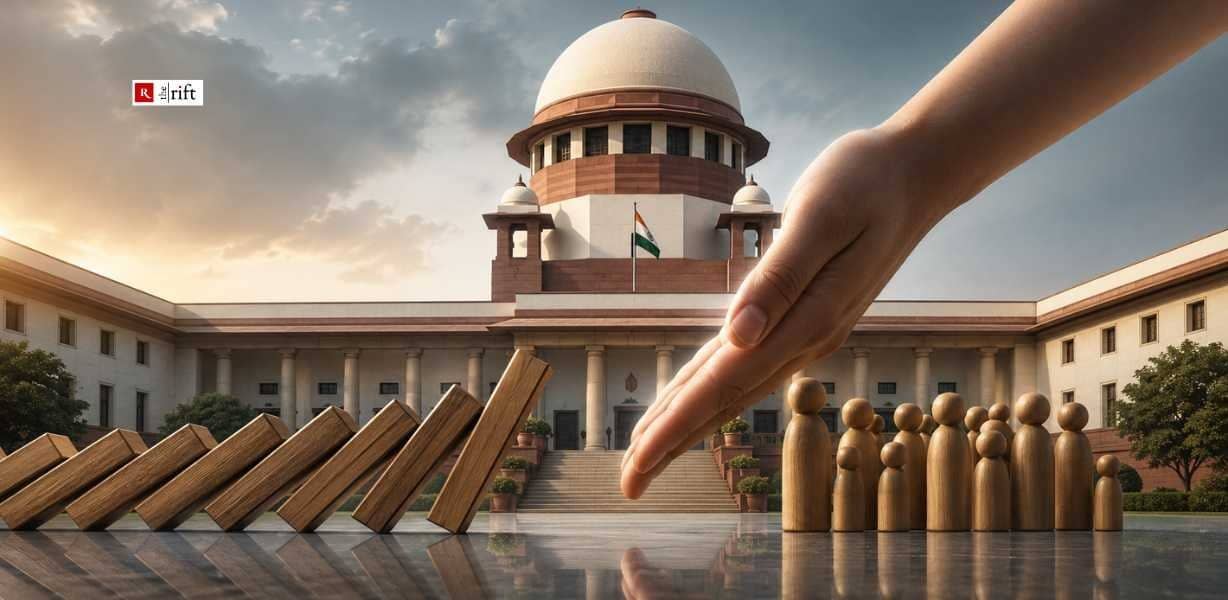
A court that is structurally more responsive to the deaths of the socially visible than to the systemic suffering of the structurally invisible is not exercising judicial power in its constitutional sense; it is exercising judicial preference.

Key Takeaways
1 of 3
Automatically generated. Read full article for complete context.
The Supreme Court’s power to take suo motu cognizanceSuo Motu CognizanceThe power of a court to take up a case on its own motion without a formal petition being filed., derived from Articles 32, 129, and 136 of the Constitution, is among the most potent instruments of Indian constitutional governance. Article 32, as Dr. B.R. Ambedkar described it in the Constituent Assembly, is “the very soul of the Constitution and the very heart of it,” and it is from this provision that the Court draws its authority to act as the sentinel of fundamental rights without waiting for an aggrieved party to approach it.
The Court’s exercise of this jurisdiction was given its earliest formal shape in Sunil Batra v. Delhi Administration (1978 AIR 1675), where Justice V.R. Krishna Iyer treated a letter from a death-row inmate at Tihar Jail, alleging torture of a fellow prisoner, as a writ petitionWrit PetitionA formal written order issued by a higher court directing a lower court or government authority to act or refrain from acting. under Article 32. That foundational act, like the communication which transformed American jails, celebrated in “Gideon’s Trumpet”, transformed correspondence into constitutional litigation and established a jurisprudentialJurisprudentialRelating to the philosophy, theory, or science of law. basis for a Court’s capacity to act on its own motion in matters of fundamental rights.
Yet, as the Court’s recent intervention in In Re: Twisha Sharma (SMW(Crl) 4/2026) illustrates, this power continues to be exercised through a process that is discretionary in its triggers, opaque in its deliberation, and concentrated in the personalities of sitting benches. The decision to constitute a three-judge bench led by the Chief Justice of India to examine allegations of institutional bias, evidence tampering, and undue influence in the death of a 33-year-old woman whose matrimonial family includes a lawyer and a retired judge is a legitimate and necessary exercise of the Court’s constitutional function.
However, its legitimacy is inseparable from the question of consistency: whether the same institutional energy and moral urgency would be deployed in structurally identical cases where the victim does not possess social visibility and the accused does not belong to the professional judicial class.
The SC database of suo motu cases between 1990 and 2021 recorded only 46 instances in which the Supreme Court exercised this jurisdiction, a number that starkly illustrates the gap between the theoretical breadth of the power and its actual deployment. A pattern analysis of those cases reveals concentration around urban, English-language media narratives, with a corresponding structural blind spot for rural, tribal, and minority grievances. The Court’s 2024 review marked 12 suo motu cases as the highest ever in a single year, suggesting growing willingness to engage proactively, yet the demographic profile of beneficiaries has not been subjected to systematic audit.
Suo Motu Cases (1990-2021)
46
Total instances recorded over 31 years
Suo Motu Cases (2024)
12
Highest ever recorded in a single year
The Architecture of Selectivity
The architecture of this selectivity is not a matter of bad faith; it is a matter of institutional design. The Chief Justice of India, as the acknowledged “master of the roster,” holds an unreviewable administrative prerogative to constitute benches and allocate matters, a power affirmed in State of Rajasthan v. Prakash Raj (1998) and restated in Shanti Bhushan v. Supreme Court of India. In the latter, the Court held that “the Chief Justice alone has the prerogative to constitute benches of the Court and allocate cases to the benches so constituted” and that “puisne JudgesPuisne JudgesJudges of a court other than the Chief Justice. cannot pick and choose any case pending in the High Court and assign the same to himself or themselves for disposal without appropriate orders of the Chief Justice.”
The concentration of suo motu discretion within this singular administrative office means that the Court’s choice of what constitutes an emergency worthy of proactive cognizance is, structurally, a function of one individual’s worldview, media exposure, and institutional priorities. No written standard governs the selection; no institutional record explains declinations.
This structural deficiency is not new to scholarly notice. The Sunil Batra Court recognized that the elasticity of Article 32 was both its virtue and its vulnerability: the same formlessness that permitted the Court to convert a prisoner’s letter into a writ petition also permits it, without institutional constraint, to remain indifferent to thousands of similar representations that never reach a bench.
The Court in Hussainara Khatoon v. State of Bihar (1979) 3 SCC 1 demonstrated that the right to a speedy trial inheres in Article 21 as a fundamental right, and that institutional failure to vindicate it warranted suo motu attention. Yet the decades following that landmark judgment have not produced a consistent institutional mechanism for applying the same logic to analogous patterns of state failure affecting the poor.
The most structurally necessary reform is the codification of transparent, legally cognizable triggers for suo motu intervention. The Twisha Sharma order, in initiating proceedings on the basis of “media reports and other attending circumstances,” reproduces the same formulation that has governed suo motu cognizance since Sunil Batra: an ad hoc, media-responsive standard that, whatever its flexibility in individual cases, is constitutionally insufficient as a general framework.
It locates the trigger entirely within the subjective perception of the sitting bench and is incapable of delivering equal treatment to those who lack access to media channels that project their suffering onto the consciousness of a sitting judge. However, even absent such projection, do not newspapers and viral social media reports repeatedly point to lynchings, unregulated demolitions, State excesses and hate speech?
Four Objective Triggers
A constitutionally sound framework should codify four objective triggers for suo motu cognizance. The first is systemic pattern evidence: verified reports from statutory bodies such as the NHRCNHRCNational Human Rights Commission, a statutory public body responsible for the protection and promotion of human rights., State Human Rights Commissions, or the NALSANALSANational Legal Services Authority, which provides free legal services to the weaker sections of society., documenting a recurring pattern of institutional failure affecting a definable class of persons. The second is an impunity indicator: evidence that the primary investigative or adjudicatory mechanism is structurally compromised, whether because the accused holds institutional authority over the investigation as in Twisha Sharma, or because the investigating agency has a documented record of non-compliance with prior judicial directions in similar matters. The third is a fundamental rights nexus: a demonstrable, non-speculative threat to Articles 14, 17, 21, or 22 that cannot be adequately vindicated through ordinary petition mechanisms. The fourth, and most important from the standpoint of equality, is a vulnerability amplifier: the intervention threshold must be inversely calibrated to the structural capacity of the affected population to access justice through ordinary channels.
Trigger 1
Systemic Pattern Evidence
Verified reports documenting a recurring pattern of institutional failure affecting a definable class.
Trigger 2
Impunity Indicator
Evidence that the primary investigative or adjudicatory mechanism is structurally compromised or non-compliant.
Trigger 3
Fundamental Rights Nexus
A demonstrable, non-speculative threat to core constitutional rights unaddressable via ordinary petitions.
Trigger 4
Vulnerability Amplifier
The intervention threshold must be inversely calibrated to the affected population’s capacity to access justice.
Custodial detainees, internally displaced tribal communities, minorities under preventive detentionPreventive DetentionThe imprisonment of a person with the aim of preventing them from committing further offenses or of maintaining public order., and stateless persons face systemic barriers to filing petitions that no codified threshold can ignore without violating the guarantee of Article 14. This codification has a meaningful comparative referent in Section 172(1)(b) of the Constitution of South Africa, which requires constitutional courts to make orders that are “just and equitable” with specific and enforceable attention to the impact on vulnerable groups, a standard that has generated a body of systemic relief jurisprudence the Indian Court has praised in its comparative constitutional reasoning but not replicated institutionally.
A Permanent Registry
The codification of threshold criteria alone is insufficient unless accompanied by an institutional mechanism that applies those criteria consistently and accounts for every representation received. The creation of a permanent Suo Motu Cognizance Registry, as a dedicated administrative organ of the Court separate from the ordinary filing apparatus, would address what scholars have identified as the “invisible docket” problem, namely the vast number of representations from civil society, legal aid organizations, and bar associations that are informally absorbed, diverted, or simply ignored without leaving institutional record.
The Registry, constituted by a rotating panel of three designated judges with annual tenure, would receive representations from civil society bodies, bar councils, NHRC, State Human Rights Commissions, and State Legal Services Authorities. Its operating protocol would be non-discretionary: every representation received must be disposed of by a reasoned written order, either admitting the matter for suo motu cognizance or formally declining it with stated reasons, within twenty-one days of receipt.
All declined representations, together with the stated reasons, must be placed in the public domain. This transparency requirement is the institutional mechanism through which the pattern of the Court’s decisions becomes visible to academic scrutiny, civil society accountability, and the bar, enabling the detection of structural biases in the Court’s exercise of discretion over time.
The In Re: Inhuman Conditions in 1382 Prisons suo motu proceeding, initiated in 2013 and decided in September 2018, demonstrates both the transformative potential of this jurisdiction and the limitation of its present architecture. The Court’s comprehensive directions on prison overcrowding, undertrial release, legal aid access, and medical facilities were the product of judicial concern, not of any institutional protocol.
A Registry mechanism would have ensured that analogous representations from tribal detention facilities, minority-dominated jails, and AFSPAAFSPAArmed Forces (Special Powers) Act, which grants extraordinary powers to the armed forces in disturbed areas.-affected detention centres received the same institutional scrutiny, rather than depending on the accident of bench composition and media visibility.
The roster system, as currently constituted, creates a structural concentration of suo motu power that is incompatible with the Court’s constitutional obligation to deliver equal justice. The Chief Justice’s unchecked authority to allocate sensitive suo motu matters to personally selected benches has been the subject of sustained criticism, most visibly in the unprecedented press conference of January 2018 by four senior puisne judges, who publicly questioned the roster allocation in matters of constitutional significance.
The SC analysis of the Chandrachud and Lalit courts found that the absence of a publicly defensible allocation rationale created what it identified as a crisis of “process legitimacy” independent of the merits of individual decisions. Reform requires, at a minimum, the introduction of algorithmic randomization in the allocation of all suo motu matters involving fundamental rights, removing the power of selective bench constitution in this class of cases.
Mandatory recusal protocols, requiring any judge with prior professional, familial, or institutional association with the accused, the investigating agency, or the referring institution to recuse, with the recusal decision entered into the public court record, must accompany this reform. The Court has in several cases enunciated the principle that justice must not only be done but must be seen to be done; the roster system, as applied to suo motu proceedings, presently fails this test.
Empowering Subordinate Courts
Perhaps the most consequential institutional deficit, and one that has acquired renewed urgency in the current political climate, is the near total absence of a meaningful suo motu jurisdiction in the subordinate judiciary. Across large parts of the country, a visible pattern has emerged: State governments, emboldened by majoritarian sentiment, have adopted postures of institutional belligerence toward religious minorities, and law enforcement agencies have operated with impunity in the targeting of those citizens, the Supreme Court in New Delhi is not a practical remedy; it is an aspiration. Their sole encounter with institutional justice occurs at the level of the District Court or the Sessions Court, before a judge who presently lacks the clear statutory authority, the institutional culture, and the administrative protection to act on his own motion when a fundamental rights violation unfolds before him.
This is not merely a gap in judicial architecture; it is a constitutional failure that renders the guarantee of Article 21 largely notional for the most vulnerable sections of Indian society. The argument that suo motu cognizance is too grave a power to vest in subordinate courts underplays the nature of the constitutional crisis confronted.
When State machinery itself becomes an instrument of persecution, the citizen cannot be left entirely dependent on a Court that is geographically, financially, and procedurally remote. The District Judge, present in every district of the country, is the constitutional officer best placed to be the first and most immediate responder to institutional bias. Suo motu intervention at that level would transform the guarantee of Article 14 from a jurisprudential abstraction into a felt, lived reality for the common citizen.
The Supreme Court itself acknowledged the structural gap in In Re: Custodial Violence and Other Matters Relating to Prison Conditions (2023), where the bench observed that the directives issued in the prison conditions cases had gone largely unimplemented at the district level, suggesting not only executive non-compliance but a systemic failure in judicial oversight at subordinate levels.
Strengthening this pipeline requires amending the BNSSBNSSBharatiya Nagarik Suraksha Sanhita, the new procedural criminal code replacing the CrPC. to create a Category A suo motu provision expressly empowering District Judges and Sessions Judges to take cognizance in cases of custodial deaths, enforced disappearances, communal violence, and documented institutional targeting of identifiable communities, placing a duty, not a discretion, on the court to act when credible material of a constitutional violation is brought to its notice or arises from proceedings before it.
The National Judicial Academy must integrate suo motu jurisprudence systematically into its training modules for district judges, with specific attention to the constitutional duty articulated in D.K. Basu v. State of West Bengal (1997) 1 SCC 416 to protect individuals from institutional excess. Appellate immunity protection for judges who exercise good-faith suo motu powers must be formalized to remove the chilling effect that currently shapes judicial inaction at the district level, ensuring that a judge who intervenes to protect a minority citizen from State excess is not thereafter punished through administrative transfer or adverse service consequences.
The Supreme Court’s institutional legitimacy as the ultimate guarantor of fundamental rights rests, in the long run, not on any individual landmark judgment but on the structural consistency of its engagement with the claims of the powerless. As the Court observed in E.P. Royappa v. State of Tamil Nadu (1974) 4 SCC 3 at paragraph 85, “equality is a dynamic concept with many aspects and dimensions and it cannot be ‘cribbed, cabined and confined’ within traditional and doctrinaire limits.”
The application of this principle to the Court’s own institutional conduct demands that the exercise of suo motu jurisdiction be subjected to the same non-arbitrariness standard that the Court applies to executive action under Article 14. The Court should publish a reasoned intervention policy, not a binding procedural code but a jurisprudential statement articulating the principles that guide suo motu cognizance, comparable in function to the Practice Directions issued by the UK Supreme Court and the administrative protocols governing the systemic relief jurisdiction of the Constitutional Court of South Africa.
The Law Commission, building on its existing suo motu disclosure framework, should be engaged to produce a dedicated report on suo motu reform incorporating inputs from legal aid organizations, civil society bodies, and representatives of marginalized communities. An annual suo motu review committee, composed of retired judges, academics, and civil society representatives, should examine whether the Court’s intervention pattern across each year reflects the constitutional mandate of Articles 14 and 21 and the basic structure doctrine’sBasic Structure DoctrineA judicial principle that certain fundamental features of the Constitution cannot be altered or destroyed through amendments by the parliament. guarantee of substantive equality.
The legitimacy of suo motu jurisdiction ultimately rests not on its frequency but on its structural fidelity to the Constitution’s foundational commitment to equality. As the National Law School India Review has argued, suo motu jurisdiction is constitutionally defensible only as “a tool for complete justice,” and the Court in State of Andhra Pradesh v. S. Vishwanatha Raju recognized that this completeness cannot be achieved selectively.
A court that is structurally more responsive to the deaths of the socially visible than to the systemic suffering of the structurally invisible is not exercising judicial power in its constitutional sense; it is exercising judicial preference. The reforms proposed here, codified thresholds, a permanent Registry, roster randomization, a constitutionally empowered district judiciary, and enforceable transparency obligations, are more than just a few administrative conveniences.
They are the institutional prerequisites for the Court’s compliance with its own constitutional mandate. The transformation of suo motu jurisdiction from a discretionary instrument of elite-adjacent justice into a principled and universally accessible tool of constitutional protection is not a matter of judicial grace; it is a matter of constitutional obligation.
Jai Hind
Disclaimer:The views and opinions expressed in this article are those of the author(s) and do not necessarily reflect the official policy or position of The Rift.