Opening The Rift
therift
© 2026 The Rift. All Rights Reserved.
NIA’s Mandate: Constitutional Limits and the Chilling Effect on Democratic Dissent
Applying specialized counter-terrorism mechanisms to public agitations conflates democratic protest with national security threats, serving as a means of intimidating citizens.

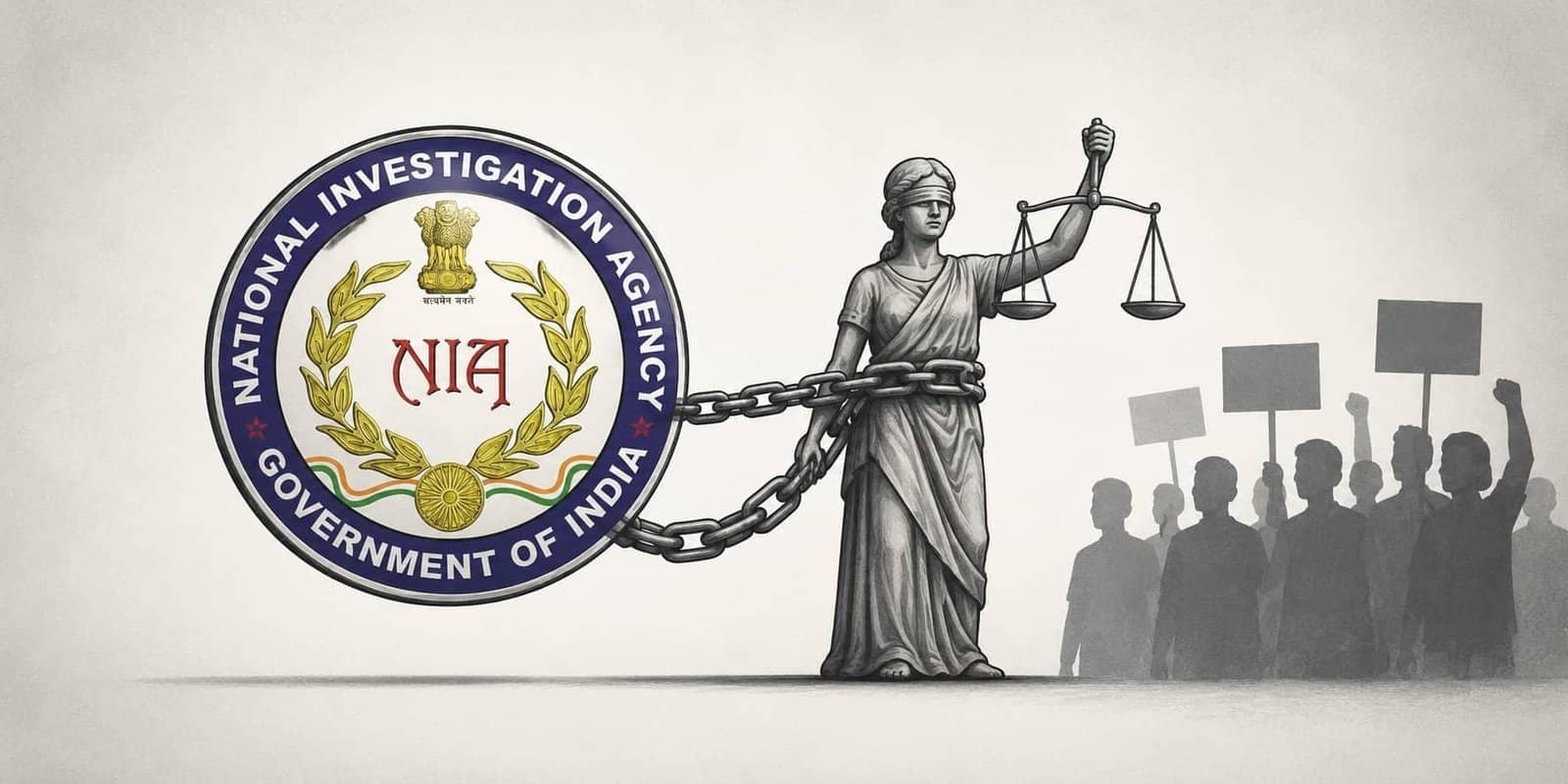
The NIA’s mandate and its impact on democratic dissent in India (Representative Image)
Key Takeaways
1 of 3
Automatically generated. Read full article for complete context.
Public Interest Litigations (PILs) seeking probes by specialized anti-terror agencies : such as the National Investigation Agency (NIA) : into civil demonstrations or student protests frequently surface in legal discourses. A PIL in Delhi is to be heard. The government has not decided that the NIA should carry out an investigation because it is well aware that the NIA has no such mandate : it is a citizen who has filed the proceeding seeking a direction from the court so that the NIA then has an excuse to be able to investigate something which is actually beyond it’s jurisdiction.
Examining the NIA’s statutory origin, its legal boundaries, and the constitutional implications of attempting to deploy anti-terror machinery against public dissent provides essential context on Indian FederalismSystem of GovernanceA system of government in which power is divided by a constitution between a central authority and various constituent political units, such as states or provinces. and civil liberties.
The National Investigation Agency was established under the National Investigation Agency Act, 2008, enacted by Parliament in the immediate aftermath of the 26/11 Mumbai terrorist attacks.
Prior to 2008, investigating complex, cross-border or inter-state terror networks fell largely under state police forces or required ad-hoc consent mechanisms under the Central Bureau of Investigation (CBI).
The statutory objective of creating the NIA was to establish a dedicated, centralized federal agency capable of countering sophisticated, trans-national terrorism, terror financing, and asymmetric security threats.
Statutory Scope and Actual Mandate of the NIA
Under Section 3 and Section 6 of the NIA Act, the agency’s jurisdiction is strictly tied to offenses listed in its Schedule of Offences.
NIA’s Statutory Mandate & Evolution
Original Mandate (NIA Act, 2008)
- ✓ Unlawful Activities (Prevention) Act, 1967 (UAPA)
- ✓ Offenses against National Sovereignty & Security (IPC/BNS)
- ✓ Counter-Terror & High-Security Statutes (e.g., Explosive Substances Act)
2019 Amendments: Expanded Coverage
- ● Human trafficking
- ● Cyber-terrorism
- ● Counterfeit currency (FICN)
- ● Offenses against Indian citizens/interests abroad
VISUALS BY THE RIFT
The NIA does not possess blanket authority to investigate standard law-and-order incidents, civil disobedience, or public unrest.
Scheduled Offences Under the NIA Act
- The agency’s statutory scope is limited to: The Unlawful Activities (Prevention) Act, 1967 (UAPA), covering terrorist acts, membership in banned outfits, and funding terror.) : Terrorist acts, membership in banned outfits, and funding terror.
- Offenses against National Sovereignty & Security: Chapters VI and VIII of the Indian Penal Code (IPC) / Bharatiya Nyaya Sanhita (BNS) relating to waging war against the state.
- Counter-Terror & High-Security Statutes
- The Explosive Substances Act, Atomic Energy Act, Weapons of Mass Destruction Act, Maritime Navigation safety laws, and the Arms Act.
2019 Amendments
Expanded coverage to human trafficking, cyber-terrorism, counterfeit currency (FICN), and offenses committed against Indian citizens/interests abroad.
Standard Law and Order vs. NIA Mandate
Under Schedule VII, List II (State List) of the Constitution of India, ‘Public Order’ and ‘Police’ are primary state subjects.
Ordinary civic protests, street demonstrations, traffic blockades, or local acts of vandalism fall squarely under ordinary criminal law (e.g., standard IPC/BNS sections and local Police Acts).
As established in high court jurisprudence, including the Delhi High Court’s refusal to entertain PILs seeking NIA intervention into public demonstrations, the transfer of an investigation to the NIA is a statutory decision vested in the executive branch based on national security thresholds, rather than an automatic remedy for civic disruption.
Legal and Political Criticisms of Expansive Mandates
Socio-legal scholars and human rights advocates frequently highlight several systemic risks when anti-terror frameworks or specialized federal agencies are invoked against political activism or student movements.
Deflection from Core Governance Issues
Demands to classify public agitations, such as student protests over examination integrity or systemic governance reforms, as “anti-national conspiracies” shift focus away from substantive policy grievances toward state security narratives.
Chilling Effect on Democratic Dissent
Article 19(1)(b) of the Constitution guarantees the fundamental right to assemble peaceably without arms. Applying federal anti-terror statutes to public demonstrations introduces harsh bail restrictions (such as Section 43D(5) of UAPA) and prolonged pre-trial detention, which deters citizens from exercising their constitutional rights.
Erosion of Federalism
Routinely bypassing state police apparatuses in favor of central agencies for routine protest management undermines state autonomy and strains the constitutional balance between federal powers and state jurisdiction.
Surveillance and Overreach
As highlighted in ongoing civil liberties litigation, routine use of police surveillance, facial recognition technology, and intimidation tactics during peaceful assemblies can compromise individual privacy and democratic participation.
The National Investigation Agency plays a critical role in safeguarding India’s national security against organized terrorism and trans-national threats.
However, applying specialized counter-terrorism mechanisms to public agitations conflates democratic protest with national security threats, and serves as a means of intimidating citizens from future protests.
Those who are filing such public interest litigations are probably stooges or proxies of the government who seek to misuse due process of law to leverage such proceedings creating a deterrence obstacle against those who might question the government, whose narrative they have internalised and subscribed to.
Maintaining a strict boundary between public order enforcement and specialized national security mandates remains vital for preserving both rule of law and constitutional democracy in India.
Jai Hind
Disclaimer:The views and opinions expressed in this article are those of the author(s) and do not necessarily reflect the official policy or position of The Rift.
*National Investigation AgencyCivil LibertiesConstitutional LawDemocratic DissentIndian FederalismPublic Interest LitigationsUAPA