Opening The Rift
therift
© 2026 The Rift. All Rights Reserved.
Where ignorance is bliss: Short-Sighted Policing Punishes the Vulnerable
The proposed one-way traffic scheme around KBR Park is an ill-considered, short-sighted administrative experiment that will actively harm cyclists and less-affluent residents.

Key Takeaways
1 of 3
Automatically generated. Read full article for complete context.
One-Way folly around KBR park is a short-sighted policing that punishes the vulnerable and ignores reality.
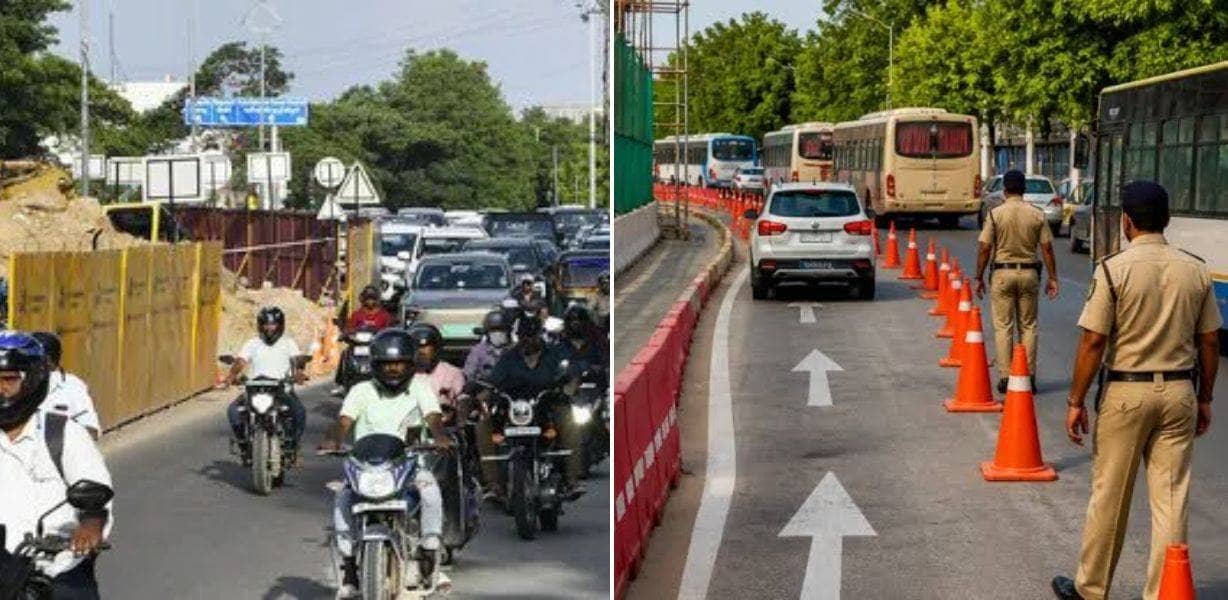
The proposed one-way traffic scheme around KBR Park is being sold as a progressive solution to congestion and construction-related chaos.
In reality, it is an ill-considered, short-sighted administrative experiment that is likely to prove counterproductive. It rests on thin to the point of non-existent evidence, ignores basic urban realities, and will actively harm cyclists and less-affluent residents while further insulating the city’s more privileged zones from the everyday burdens of mobility.
The plan’s foundation is remarkably weak. Two brief pilot trials : one lasting three hours and another six hours : are being treated as sufficient justification for a two-year, full-time conversion of a major multi-junction urban corridor ! These limited, off-peak windows cannot capture weekday peak flows, school and office rushes, monsoon disruptions, or the cumulative effects of ongoing construction.
Extrapolating a permanent structural change from such fragmentary data is not planning : it is wishful thinking dressed up as expertise.
Officials claim commuters will adjust “in about a week.” This underestimates how slowly habits stabilise around a high-density outer-ring corridor already being reshaped by 110 pillars, flyovers and underpasses. Major one-way conversions of this scale typically require months, not days, for behavioural adaptation : especially when the road geometry itself keeps changing. Treating public adaptation as a trivial, short-term inconvenience reveals a detachment from lived experience.
The emergency-vehicle assurances are particularly troubling. The corridor hosts roughly ten major hospitals. A rigid one-way system forces ambulances and fire tenders approaching from the opposite direction into long circumferential detours. Dedicated Lane II markings and personnel assistance cannot erase the extra kilometres and minutes. In a medical emergency, those minutes are not administrative details : they are life-and-death variables. The plan prioritises alleged flow aesthetics over emergency access.
Enforcement is being positioned as the fix for every structural flaw. Round-the-clock police deployment, drones and CCTV for two years are presented as the solution to wrong-side driving and bottlenecks. Heavy, perpetual policing is not a sign of a robust design : it is an admission that the geometry is unintuitive and imposes excessive detours.
When a one-way loop makes short local trips irrationally long, wrong-side movement becomes a predictable systemic response rather than isolated deviance.
Relying on endless coercion to suppress that response is neither sustainable nor intelligent.
Claims that the scheme will cut pollution and reduce time spent on the road collapse under basic scrutiny. Converting a two-way perimeter into a one-way loop forces vehicles travelling short distances in the “wrong” direction to cover significantly greater distances. Increased vehicle-kilometres travelled raise fuel consumption and overall emissions even if local speeds improve. Air quality suffers. Downstream merge points and residual construction bottlenecks will still generate idling. Idling burns fuel, carbon emissions are inhled by auto borne students and two where riders, while affluent travellers in air conditioned cars, face no such issues.
The net environmental and time benefits are far from guaranteed, while the additional distance is.
Median-width reductions at selected locations are offered as compensation for carriageway lost to construction. Yet the installation of 110 pillars, heavy equipment movements, temporary barriers and safety buffers will rapidly consume any marginal space gained. The result is likely to be a narrower effective road under permanent construction pressure rather than meaningful additional capacity.
Beyond these operational failures lies a deeper social cost. Long one-way stretches actively disincentivise cycling. Cyclists already navigate hostile conditions, and forcing them into extended loops or dangerous interactions with diverted motor traffic further erodes the viability of non-motorised travel. The same geometry pushes less-affluent residents : those without the option of private cars, flexible work hours or multiple vehicles : onto longer, costlier routes. It distances them from employment centres, markets and the “happening” parts of the city, effectively marginalising and impoverishing people already operating with limited resources.
Mobility policy that treats the relatively poorer as residual traffic to be rerouted is not neutral infrastructure management : it is regrettable social sorting by road design.
Past experiments of this kind were publicly framed as popular successes. Many residents experienced them differently : as prolonged inconvenience, increased daily friction and administrative indifference to cumulative hardship. People are fed up. The pattern of announcing dramatic geometric changes, celebrating them as progressive, and then relying on heavy enforcement while dismissing lived complaints has eroded trust.
It is past time for the administration and traffic police to sit up and register the actual public mood rather than the curated narrative of smooth adjustment and civic gratitude.
A serious traffic intervention around KBR Park would begin with rigorous, peak-period data, genuine modelling of emergency access and equity impacts, and honest acknowledgment of the costs imposed on cyclists and lower-income travellers.
What is currently on offer does none of that. It is short-sighted, counterproductive and socially regressive. The city deserves better than another round of ill-considered one-way experiments imposed from above.
Jai Hind
Disclaimer:The views and opinions expressed in this article are those of the author(s) and do not necessarily reflect the official policy or position of The Rift.