Opening The Rift
therift
© 2026 The Rift. All Rights Reserved.
Who Will Pay for Twenty Years of War in Afghanistan?
If international law cannot ask a powerful state to answer for the human consequences of twenty years of military intervention, then international law has revealed its deepest weakness.

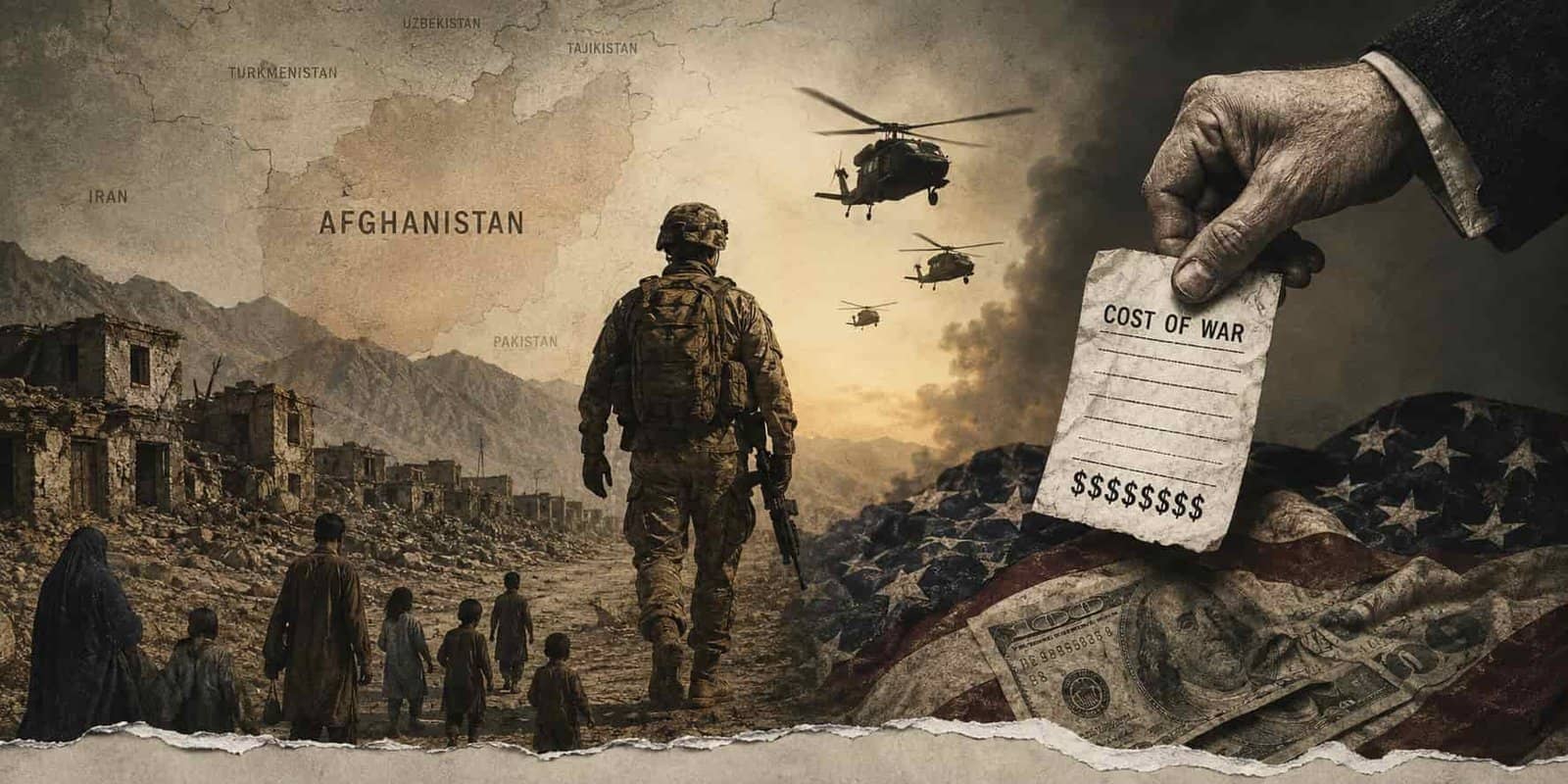
(Representative Image)
Key Takeaways
1 of 3
Automatically generated. Read full article for complete context.
An occupation can end when soldiers leave. Its moral and legal liabilities do not disappear with them
Twenty years after the United States invaded Afghanistan, the soldiers have gone home. The aircraft have gone. The bases have been abandoned. Washington has moved on to other wars, other enemies and other strategic calculations.
But Afghanistan remains.
It remains with its dead, its widows and orphans, its displaced millions, its shattered infrastructure, its ruined economy and a generation that grew up amid bombardment, occupation and war. The question that the international community has conspicuously failed to ask is a simple one:
Who pays for the destruction?
The United States spent an estimated $2.313 trillion on the Afghanistan-Pakistan war between 2001 and 2022, according to Brown University’s Costs of War project. That figure is the American cost of fighting the war, not the value of the destruction inflicted upon Afghanistan. The same research estimated 243,000 direct deaths resulting from the war in Afghanistan and Pakistan, while warning that the figure excludes deaths caused indirectly through disease, deprivation and destruction of access to food, water and infrastructure.
For Afghanistan, the human accounting is even more terrible. Brown’s estimates put direct deaths in Afghanistan at roughly 176,000, including more than 46,000 civilians. Millions more were displaced. The indirect consequences cannot be reduced to a neat statistical figure. A destroyed hospital is not merely a destroyed building. A dead breadwinner means a family pushed into poverty. A child deprived of education carries the consequences for decades.
War therefore creates a debt that cannot be measured merely by adding up bombs, bullets and military salaries. And yet there has been remarkably little discussion of reparations. Why?
Perhaps because international politics has developed a strange hierarchy of accountability. When a small state commits aggression, the vocabulary of international law becomes immediate and uncompromising. When a great power does so, the language becomes cautious, technical and diplomatic.
Afghanistan exposes that double standard.
The United States and its allies did not merely enter Afghanistan briefly. They conducted a twenty-year military intervention involving occupation, airstrikes, special operations, detention, interrogation, drone warfare and an enormous reconstruction programme. The International Criminal Court’s own preliminary examination found a reasonable basis to believe that members of the US armed forces and CIA committed war crimes including torture, cruel treatment and outrages upon personal dignity in Afghanistan and elsewhere in connection with the conflict. The Court’s material specifically described evidence involving at least 61 detainees held by US forces and at least 27 detainees allegedly abused by the CIA.
These are not merely political accusations. They entered the evidentiary record of an international criminal investigation. Nor was the reconstruction effort the clean humanitarian enterprise that its advocates sometimes portrayed.
The US Special Inspector General for Afghanistan Reconstruction, SIGARSpecial Inspector General for Afghanistan ReconstructionAn independent oversight agency created by the U.S. Congress to audit and investigate reconstruction efforts and spending in Afghanistan., reported that approximately $144.7 billion had been appropriated for reconstruction between 2002 and 2021. Its investigations identified between $26 billion and $29.2 billion in waste, fraud and abuse. Importantly, SIGAR says that about 93 percent of this amount was classified as waste rather than fraud. So it would be wrong to claim that $29 billion was simply “stolen”. But the scale of the failure is nevertheless extraordinary. SIGAR’s investigations produced 171 convictions and $1.7 billion in fines, forfeitures, settlements, recoveries and savings.
Financial Costs & Reconstruction Funds (2001-2022)
US War Spending (2001-2022)
$2.313 Trillion
(Source: Brown University Costs of War)
Reconstruction Funds Appropriated (2002-2021)
$144.7 Billion
(Source: SIGAR)
Identified Waste, Fraud & Abuse
$26 – $29.2 Billion
(Source: SIGAR)
Afghan Central Bank Reserves Frozen
$7 Billion
(Held at Federal Reserve Bank of NY)
VISUALS BY THE RIFT
This raises another question: where did Afghanistan’s money go? Afghanistan’s central-bank reserves stood at approximately $9.5 billion in 2021, with about $7 billion held at the Federal Reserve Bank of New York. After the Taliban takeover, the United States froze those assets. Washington subsequently established the Swiss-based Afghan Fund and placed $3.5 billion of Afghan central-bank reserves into it for the benefit of the Afghan people.
But these are Afghan assets. They are not American reparations. The distinction matters enormously. Afghanistan should not have to depend upon the benevolence of the country that participated in its devastation to recover money that already belonged to Afghanistan. Nor should Afghan sovereign reserves be treated as though they were compensation for American wrongdoing.
What Afghanistan needs is a Reparations and Accountability Mechanism
It could be established through the United Nations or another genuinely independent international framework. Its mandate should be to document civilian deaths, injuries, displacement, destruction of homes and infrastructure, environmental damage and economic losses. It should examine military operations as well as the reconstruction system. It should identify cases of fraud and corruption, trace recoverable assets and establish a mechanism through which victims can seek compensation.
And the mechanism must not be confined to Afghan perpetrators.
The ICC already has a jurisdictional pathway through the Afghanistan situation. It has examined allegations involving the Taliban, Afghan government forces and US personnel. International justice cannot mean justice only when the accused is politically convenient. If there is evidence of war crimes, the nationality or power of the alleged perpetrator cannot determine whether justice is pursued.
This is why the ICC should be encouraged to pursue its Afghanistan mandate with independence and without political intimidation. The Prosecutor’s proprio motu powers exist precisely because international criminal justice cannot always depend upon states voluntarily bringing cases against themselves or their allies.
Afghanistan, for its part, should not wait passively for the great powers to discover their conscience. It should demand an international accounting.
It should document the damage. It should establish a national register of victims. It should calculate economic and ecological losses. It should identify assets diverted through corruption and pursue their recovery through international legal channels. It should seek a formal international mechanism for reparations.
There will immediately be objections. These are legitimate questions. They should be answered through an impartial process, not used to prevent the process from beginning. Reparations do not mean that every Afghan loss must be attributed exclusively to Washington. Nor do they mean that other perpetrators should escape accountability. Quite the opposite: everyone responsible should be accountable according to the evidence.
But there is a particular responsibility attached to the power that launched the intervention, maintained the occupation and possessed overwhelming military superiority. A superpower cannot claim moral leadership in the world while refusing to confront the consequences of its own wars.
America has often spoken of a rules-based international order. Afghanistan provides a test of whether those rules apply to the powerful as well as the powerless.
The United States may argue that it has already spent hundreds of billions of dollars on Afghanistan. But money spent on war is not compensation for the damage caused by war. Money spent on weapons is not reparations. Money spent on military bases is not restitution. And money lost through corruption is not development.
The people of Afghanistan did not ask for the invasion. They did not ask to become the laboratory for two decades of counter-insurgency. They did not ask to have their villages searched, their homes raided, their communities displaced or their skies filled with aircraft and drones.
And when the occupying power finally left, it did not leave Afghanistan whole. The moral debt therefore remains.
The world has established tribunals for Rwanda, the former Yugoslavia and other theatres of mass atrocity. It has developed principles of restitution and compensation for victims. It has repeatedly declared that impunity is unacceptable.
Afghanistan should ask the international community to apply those principles without fear or favour. The question is no longer simply whether America won or lost its longest war. The question is whether the victims of that war are entitled to justice
If international law cannot ask a powerful state to answer for the human consequences of twenty years of military intervention, then international law has revealed its deepest weakness. And if America believes itself to be a defender of civilisation and international order, it should not wait to be forced into doing what morality requires.
Afghanistan is entitled to ask for reparations. The world is entitled to demand accountability. And the powerful are not entitled to escape either simply because they are powerful.
Disclaimer:The views and opinions expressed in this article are those of the author(s) and do not necessarily reflect the official policy or position of The Rift.